a0.dev
Contact
a0.dev
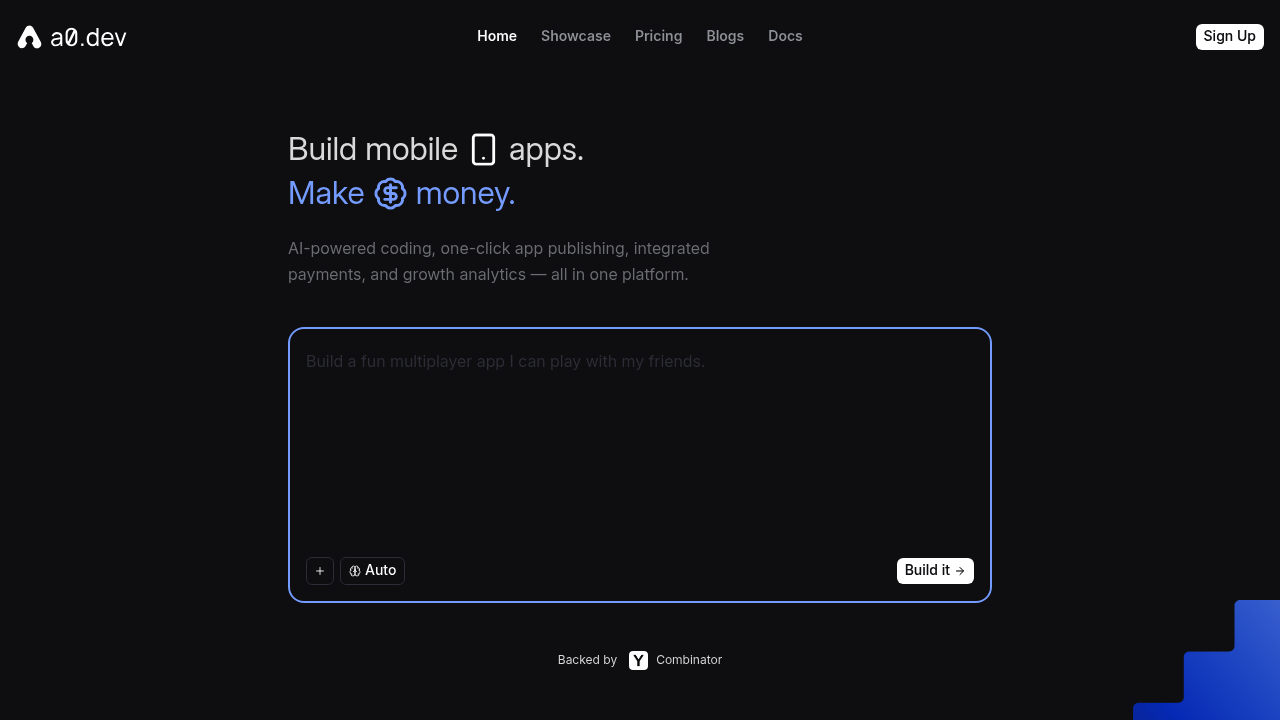
AI-powered mobile app builder (YC W25) that generates React Native apps with one-click iOS & Android App Store deployment.
a0.dev as a Replit Alternative: Comparison & Decision Guide (2026)
a0.dev is an AI-powered mobile app builder (Y Combinator W25) that generates React Native apps deployable to iOS and Android — making it a strong Replit alternative specifically for founders and indie hackers who need real native mobile output, not browser-based prototypes. Where Replit excels at web and full-stack workflows with a browser IDE, a0.dev focuses narrowly on mobile-first generation with one-click App Store and Play Store deployment.
The tradeoff: you gain a mobile-native pipeline that Replit simply does not offer, with built-in database (Convex/Supabase), auth, and app store publishing. You lose Replit's broad language support, collaborative IDE, and web deployment flexibility.
If your goal is a web app, a backend API, or a multi-language project, a0.dev is not the right choice — Replit covers those cases far better.
a0.dev vs. Replit: Quick Comparison
| Decision area | a0.dev | Replit |
|---|---|---|
| Primary approach | AI-generated React Native mobile apps | AI-assisted full-stack web/app development in browser IDE |
| Output stack | React Native (iOS & Android) | Web, backend, scripts — any language |
| AI capability | AI coding agent for mobile app generation | Replit AI (Ghostwriter) — code completion, generation, chat |
| Visual editing | Not publicly documented | Minimal — code-first, no visual drag-and-drop |
| Figma import | Not publicly documented | Not supported |
| Deployment | One-click App Store + Google Play Store | Replit-hosted web deployments; no native mobile publishing |
| Database | Convex, Supabase (built-in integration) | Replit DB (key-value); PostgreSQL via add-ons |
| Authentication | Built-in APIs (specifics not fully documented) | Not built-in; via third-party libraries |
| Mobile support | Core product — full native iOS & Android | No native mobile app publishing |
| Git/GitHub workflow | Not publicly documented | GitHub import/export supported |
| Code export / portability | React Native code (exportability not fully documented) | Full code access; can export and self-host |
| Collaboration | Not publicly documented | Real-time multiplayer collaboration in IDE |
| Error handling / debugging | AI agent handles iteration; manual debugging not documented | Built-in debugger, console, error highlighting |
| Pricing model | Free tier + Pro $20/mo | Free + Core $25/mo + Teams from $40/mo |
| Free plan | Yes — limited usage | Yes — limited compute, public Repls only |
| Paid plans | Pro $20/mo | Core $25/mo; Teams $40+/mo |
What a0.dev Does Differently
Native Mobile Publishing as the Core Output
a0.dev is built around one thing Replit cannot do: publish native iOS and Android apps directly to the App Store and Google Play. For founders who need a real mobile app — not a mobile-responsive website — this is a fundamental difference. Replit produces web deployments; a0.dev produces App Store-ready React Native bundles.
This matters because Replit's browser-based output requires significant additional work (Expo, React Native setup, App Store accounts, CI/CD) before you can ship to mobile. a0.dev packages this workflow into the product itself.
AI Agent That Owns the Mobile Stack
The AI coding agent in a0.dev is specifically trained for mobile app generation — not general-purpose code assistance. It understands navigation patterns, mobile UI conventions, and integration with Convex or Supabase as first-class database options. Replit's Ghostwriter is a general code assistant; a0.dev's agent is mobile-domain-specific.
In practice, this means faster time-to-working-mobile-app for founders with no native mobile experience, at the cost of less flexibility for non-standard use cases.
YC-Backed with Focused Infrastructure
As a YC W25 company, a0.dev has early-stage backing and a focused product thesis: AI-first mobile app creation for builders who don't want to configure a React Native environment. Built-in APIs and database integrations reduce the boilerplate setup that would otherwise block non-mobile developers from shipping a mobile product.
Replit's infrastructure is more mature and general-purpose; a0.dev bets on depth over breadth in the mobile layer.
Known Limitations
- Mobile-only output: a0.dev produces React Native apps. If you need a web app, a landing page, an API, or a backend script — this tool is the wrong choice. Replit handles all of those natively; a0.dev does not.
- Pricing risk at early stage: As a YC W25 startup, pricing and feature availability are subject to change. The Pro plan at $20/mo may evolve. There is no published enterprise tier or volume pricing. For teams or cost-sensitive projects, the trajectory is unclear.
- Limited collaboration documentation: Replit has well-documented real-time multiplayer collaboration. a0.dev's collaboration model is not publicly documented — a significant gap if you're building with a team.
- Code portability not fully documented: React Native code is inherently portable, but whether a0.dev provides full export access to the generated codebase — or locks you into their platform for iteration — is not clearly documented. This creates lock-in risk for longer-term projects.
- Debugging workflow unclear: Replit has a built-in debugger, console, and error tools. a0.dev's debugging flow relies on the AI agent iterating — the manual debugging experience for edge cases is not documented.
- Early product risk: As an early-stage product (W25 = early 2025), feature completeness, stability, and long-term availability carry higher risk than established alternatives like Replit, Expo, or Flutter toolchains.
Who Should Choose a0.dev Over Replit?
- Founders who need a native mobile app, not a web app: If your product requires App Store presence and you lack native mobile development experience, a0.dev gives you a direct path that Replit does not offer.
- Indie hackers prototyping mobile-first ideas: If you want to validate a mobile app concept quickly without configuring React Native, Expo, or app store CI/CD pipelines, a0.dev removes that friction.
- Non-developers building mobile tools for specific user bases: The AI agent model lets someone without extensive coding experience generate a functional React Native app — a use case where Replit's code-first IDE is a bigger barrier.
- Teams already using Convex or Supabase: If your stack already includes these database services, a0.dev's built-in integration reduces configuration overhead compared to setting up the same on Replit.
When Replit Is Still the Better Choice
- You're building a web application: Replit's web deployment, browser IDE, and broad language support make it far better for web projects. a0.dev has no web output path.
- You need real-time collaboration: Replit's multiplayer IDE is a documented, production feature. a0.dev's collaboration story is unclear.
- You need code transparency and control: Replit gives full code access and supports GitHub integration. If you need to own the codebase and control the CI/CD pipeline beyond mobile app publishing, Replit is more predictable.
- You're working in a language other than JavaScript/React Native: Replit supports Python, Go, Rust, Ruby, Java, and dozens more. a0.dev is React Native only.
- You need a stable, established platform: Replit has years of production use, a documented roadmap, and a mature billing model. a0.dev is a very early-stage product with more uncertainty.
Pricing Comparison & Cost at Scale
a0.dev Plan Overview
- Free tier: Available; usage limits not fully documented
- Pro: $20/mo — full feature access (specifics of what unlocks not fully documented)
Replit Plan Overview
- Free: Public Repls, limited compute
- Core: $25/mo — private Repls, more compute, AI features
- Teams: From $40/mo/user — collaboration features
| Scenario | a0.dev | Replit | Notes |
|---|---|---|---|
| Solo founder prototyping mobile app | Free → $20/mo Pro | Free → $25/mo Core | Similar entry cost; a0.dev only if mobile output needed |
| 2-person team building web app | Not applicable | $50/mo (2x Core or Teams) | a0.dev not relevant for web; Replit wins |
| Scaling mobile product with team | Not publicly documented | Teams pricing scales per seat | a0.dev has no documented team/enterprise tier |
Prices are subject to change. Check official pricing pages for the latest details. a0.dev is an early-stage product; pricing structure may evolve significantly.
How a0.dev Compares to Other Options
- vs. Expo + EAS: Expo is the industry-standard React Native toolchain. It offers more control, better debugging, and a mature ecosystem — but requires more configuration than a0.dev's AI-first approach. For experienced React Native developers, Expo is likely a better fit. For non-developers who just need to ship a mobile app, a0.dev's AI agent removes more friction.
- vs. Glide: Glide builds apps from spreadsheet data — web apps primarily. It's no-code but produces web output, not native mobile apps. If mobile-native matters, a0.dev is more relevant; if non-technical simplicity for internal tools matters, Glide may win.
- vs. Adalo: Adalo builds native iOS/Android apps visually without code. Adalo has more documented pricing, 200+ components, and a mature no-code builder — but without AI generation. If you prefer visual drag-and-drop over AI prompting, Adalo may be a better fit for mobile.
FAQ
Is a0.dev free?
Yes, a0.dev offers a free tier. The Pro plan is $20/month. Specific limits on the free tier (number of apps, generation credits) are not fully documented on the official site. Verify current free plan constraints before committing to a project.
Can a0.dev replace Replit?
Only for native mobile app use cases. a0.dev cannot replace Replit for web development, backend scripting, multi-language projects, or collaborative IDE workflows. If you specifically need to ship iOS and Android apps, a0.dev offers a path Replit doesn't. For everything else, Replit is more versatile.
What kind of apps can a0.dev build?
React Native mobile apps for iOS and Android. The AI agent generates the codebase, handles database integration (Convex, Supabase), and supports one-click publishing to the App Store and Google Play. Web app output is not a supported use case.
Is a0.dev good for non-developers?
Yes, in theory — the AI agent model is designed to lower the barrier for mobile app creation without requiring React Native expertise. However, as an early-stage product, edge cases and complex requirements may still require debugging knowledge. It's better suited to technically adjacent founders than complete non-coders.
What is the lock-in risk with a0.dev?
Moderate to high uncertainty. React Native itself is open-source, but whether a0.dev provides full export access to the generated code — or ties you to their platform for future iterations — is not fully documented. As an early-stage YC startup, platform continuity also carries more risk than established tools.