
Anything
Contact
Anything
AI app builder that turns conversations into web and mobile apps with built-in backend services.
Anything as a Replit Alternative: Comparison & Decision Guide (2026)
Anything is a strong Replit alternative for founders who want an AI agent to assemble not just a website, but a fuller app package with backend, database, auth, hosting, and even mobile ambitions inside one conversational workflow.
The trade-off is that Anything pushes much harder on agent-led generation and managed infrastructure, while Replit still gives buyers more direct visibility and control over how the software is actually constructed and maintained.
If you want the AI to behave more like a builder than an assistant, Anything is compelling. If you want the AI to accelerate a codebase you actively own, Replit is usually the safer choice.
Anything vs. Replit: Quick Comparison
| Decision area | Anything | Replit |
|---|---|---|
| Primary approach | AI agent that builds web and native mobile apps from conversation | AI coding platform centered on code and deployment |
| Output stack | Managed app builder with backend, database, auth, payments, and hosting built in | Code workspace with hosting and developer tooling |
| Builder style | Agent-first app creation | Developer workspace with AI assistance |
| Web output | Officially supported | Officially supported |
| Native mobile | Official docs say iOS and Android apps are supported | Not the strongest part of Replit's public story |
| Database | Official docs say database is built in | Databases and storage are available, but via a coding workflow |
| Authentication | Official docs say auth is built in | Available, but more developer-led |
| Payments | Official docs mention Stripe and RevenueCat on paid plans | Possible, but integration work is more manual |
| Hosting | Official docs say hosting is built in | Built-in deployment is a Replit strength |
| Portability | Not publicly positioned as a code export-first platform | More transparent for code ownership |
| Testing | Max plan mentions automated testing and a browser agent | Testing is flexible but usually more manual and code-shaped |
| Pricing model | Credits plus tiered plan features | Platform subscription plus developer usage patterns |
| Free plan | Docs mention 3k credits to try it out | Less beginner-friendly as a pure app-builder free path |
| Paid entry | Docs mention Pro and Max; pricing page shows a much higher high-end plan | Can be cheaper than high-end AI builders if you need code control |
| Best fit | Founders wanting full-stack app generation, including mobile ambitions | Builders who want a coding environment with AI, not a black-box app agent |
What Anything Does Differently
It sells a fuller 'idea to product' package than most Replit alternatives
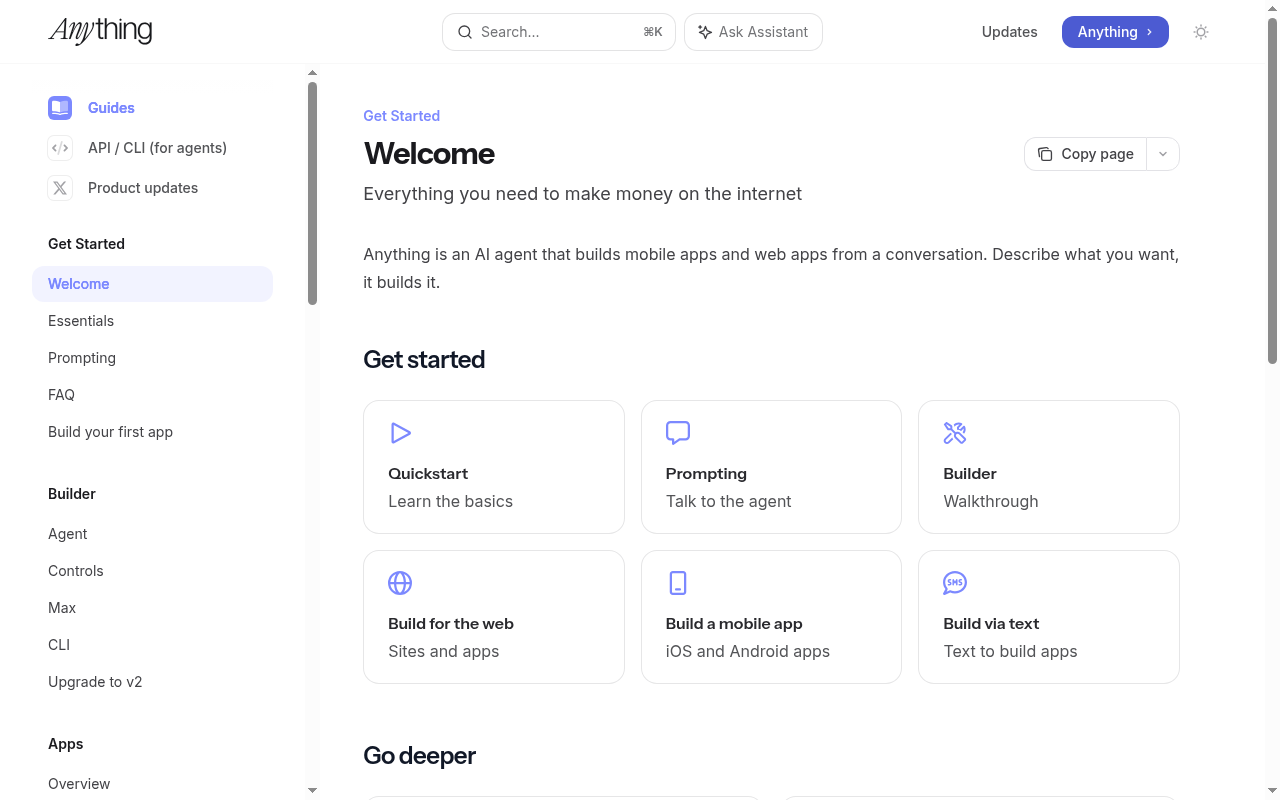
Anything's official docs do not stop at website generation. They say the platform builds mobile apps and web apps from conversation, and the essentials page goes further by naming design, backend, database, auth, payments, hosting, and App Store submission as part of the product story.
That is a meaningful difference versus Replit. Replit is a better development environment, but Anything is trying to be a more complete app-production machine for non-technical builders.
It pushes native mobile much harder
Many AI app builders are really web app builders with responsive layouts. Anything explicitly documents native iOS and Android ambitions. Even with caveats about evolving support, that broadens its relevance in a Replit-alternative search because mobile is a real boundary for many builder-first products.
If your roadmap includes both web and mobile from the start, Anything is easier to justify than tools that quietly avoid that conversation.
Higher-end plans add automated QA and agentic fixing
The pricing materials highlight features like visual QA with a computer-use agent, automated testing, and larger context windows on higher plans. That signals a product that wants to own more of the refinement loop, not just the first generation.
Replit can absolutely support testing and iteration, but it expects you to manage more of that workflow yourself. Anything is more attractive when you want the platform to keep carrying the execution burden.
Known Limitations
- Pricing is not as straightforward as it first appears. Public materials combine plan pages, credit pages, and subscription docs, which means buyers need to verify the current structure before committing.
- Credits introduce usage uncertainty. A generous feature list can still become expensive quickly if your workflow depends on repeated agent runs, heavy app generation, or AI-powered production features.
- Managed infrastructure is convenient, but it raises the classic lock-in question. Replit is usually clearer if code ownership and migration optionality are strategic requirements.
- Mobile support is explicitly described as evolving. That is better than pretending the capability is finished, but it also means serious mobile buyers should expect rough edges.
- Anything looks strongest for founder-led momentum, not for teams that already know they want a durable, developer-governed software workflow from the first week.
Who Should Choose Anything Over Replit?
- Founders who want a single AI product surface for app generation, backend setup, auth, payments, and publishing momentum.
- Non-technical builders who need both web and mobile ambition without assembling multiple tools manually.
- Solo product people who value speed and integrated infrastructure more than direct code-level control.
- Teams experimenting with app ideas where the fastest path to something real matters more than elegant engineering from day one.
When Replit Is Still the Better Choice
- Stay with Replit if your team wants to understand, edit, and own the software at code level rather than rely on a managed agentic stack.
- Stay with Replit if the project will need sustained debugging, custom architecture, or long-run engineering maintenance.
- Stay with Replit if your buyers or internal stakeholders are sensitive to platform lock-in and want clearer portability from the start.
- Stay with Replit if the product has already moved beyond idea validation and into real software stewardship.
Pricing Comparison & Cost at Scale
Plan overview
- Anything docs list a Free plan with 3k credits to try it out.
- Anything docs list Pro with private projects, custom domains, App Store publishing, and payments support.
- Anything docs list Max with smarter AI models and a browser agent that tests and fixes issues.
- The public pricing page also shows a much larger high-end paid tier example at $199/month with large credit allocations.
Prices are subject to change. Check the official pricing and subscription pages for the latest details.
Anything's cost story is less about flat software access and more about how much autonomous work you want the platform to do on your behalf. That can be worth it when the alternative is not building at all.
Replit usually wins the cost discussion for technically capable teams that do not need a black-box agent to manage the whole build. Anything usually wins when you value integrated momentum over engineering purity.
| Scenario | Anything | Replit | Notes |
|---|---|---|---|
| Founder MVP with backend included | Very strong fit | Possible, but more hands-on | Anything wins when you want the platform to own more of the stack. |
| Web + mobile ambition | More compelling on paper | Less native to Replit's positioning | Anything documents mobile more clearly. |
| Long-term software ownership | Potentially costly and more locked-in | Usually safer | Replit is better if code stewardship matters from the start. |
Migration, Lock-in, and Team Fit
Anything sits in an interesting middle ground. It is more ambitious than a simple no-code surface because it claims responsibility for backend, database, auth, payments, hosting, and even mobile publishing workflows. But that same convenience can make migration harder later if the platform remains the place where too many critical decisions are hidden.
For some buyers, that is an acceptable bargain. A founder who needs momentum now may rationally choose a platform that is a little more opinionated if it gets the first product into users' hands far faster. For other buyers, especially teams that already have developer capacity, Replit is often the better long-term bet because the code and infrastructure story is easier to reason about.
Team fit is therefore the deciding factor. Anything is a better Replit alternative for builder-led startups, solo founders, and non-technical operators who want the system to shoulder more execution. Replit is better for technical teams that want AI leverage without surrendering architectural visibility.
That distinction also changes how mistakes feel. In Anything, a weak generation can still be acceptable if it saved hours and revealed the right direction. In Replit, weak output is more painful because the value proposition is tied more tightly to maintainable software practice over time.
How Anything Compares to Other Options in Directory 2929
- Compared with Same.new, Anything pushes further into full-stack and mobile output rather than focusing mainly on web app generation.
- Compared with Frontly, it feels more agentic and infrastructure-complete, but less obviously centered on portals and dashboards.
- Compared with Replit, it is less about coding and more about having the system assemble and maintain more of the initial product surface for you.
FAQ
Is Anything free?
Yes, to try. The docs mention a free plan with 3k credits, but serious building usually moves into paid tiers quickly.
Can Anything replace Replit?
Yes, for founder-led generation. It can replace Replit when you want a managed AI app builder more than a coding environment.
How does Anything compare with Replit for developers?
Replit is better for developers. Anything is better when you want agent-led product assembly with more built-in infrastructure from the start.
What is Anything best at?
Fast full-stack momentum. Its clearest public promise is that it can build web and mobile apps with backend, database, auth, payments, and hosting in one system.
Is Anything good for beginners?
Yes, with caveats. It is beginner-friendly in workflow, but credits, lock-in, and evolving mobile support still require adult decision-making.
Does Anything support mobile apps?
Yes, officially. The docs explicitly mention native iOS and Android app building, although the product also warns that mobile support is still evolving.