
CatDoes
Contact
CatDoes
AI app builder for teams that want one product to generate mobile apps, websites, backend services, and app-store-ready builds from a prompt-driven workflow.
CatDoes as a Replit Alternative: Comparison & Decision Guide (2026)
CatDoes is one of the strongest Replit alternatives for people who care specifically about shipping mobile apps and websites from a single AI-guided product surface. It is more opinionated than Replit, but it also covers workflows that Replit does not naturally package as tightly, especially around native mobile output and app-store release.
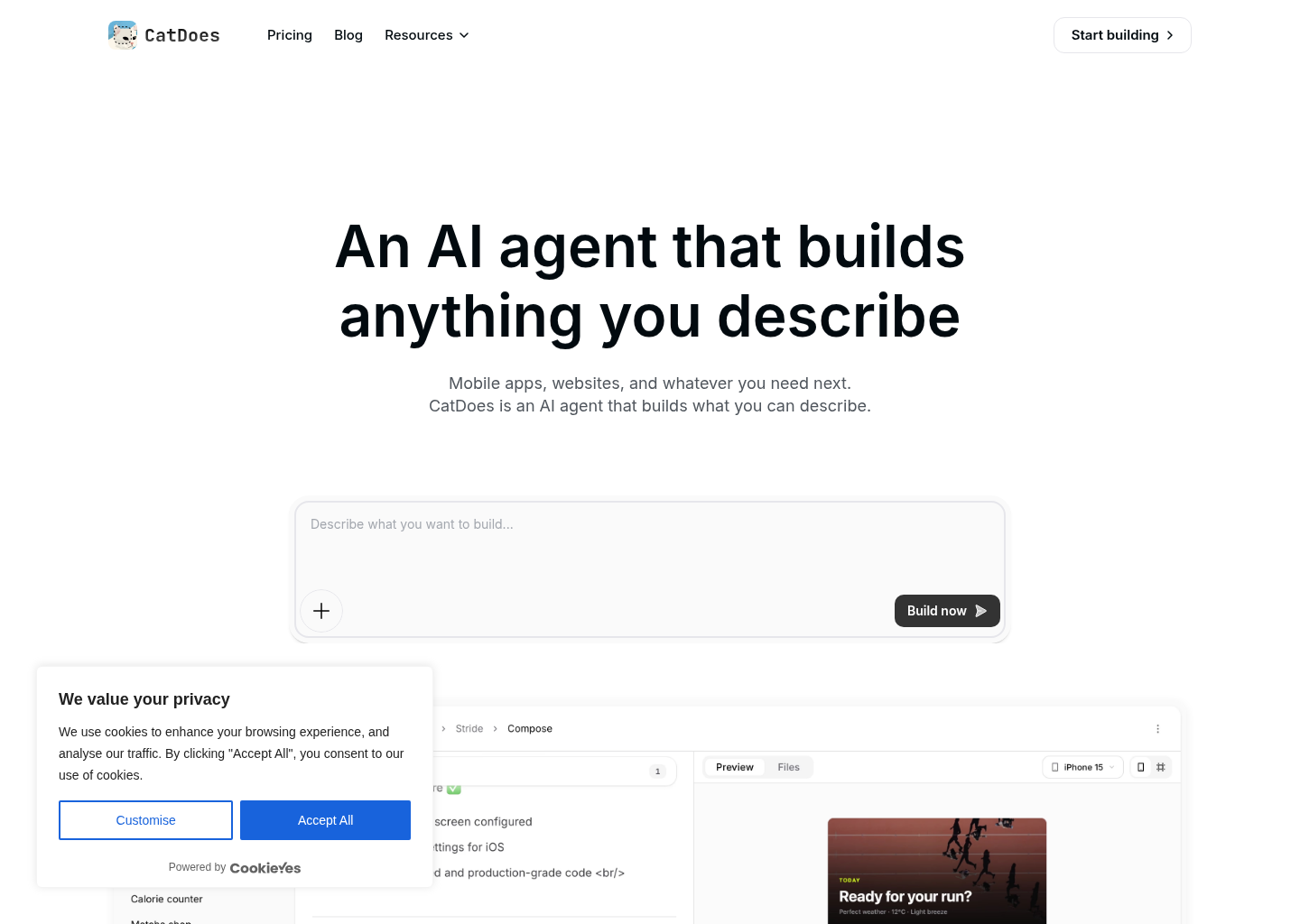
Compared with Replit, CatDoes is less like a coding environment and more like an AI app production system. The official site describes an autonomous cloud agent that writes code, runs tests, builds the backend, and prepares releases for iOS, Android, and the web. That can be a better fit than Replit when the real goal is launching an app, not working inside a browser IDE.
It is a worse fit if your team needs broad coding freedom, language choice, or a repository-native engineering culture first. CatDoes is powerful precisely because it narrows the workflow into a guided app-building lane, and that same constraint can feel limiting for experienced developers who want Replit's wider technical surface.
CatDoes vs. Replit: Quick Comparison
| Decision area | CatDoes | Replit |
|---|---|---|
| Primary approach | AI app builder with an autonomous cloud agent | Coding environment with AI help inside a broader development workflow |
| Best fit | Builders who want mobile apps, websites, and app-store release support | Developers who want a flexible coding workspace |
| Output stack | React Native Expo for mobile and Vite or Next.js for websites | General project output across many app and runtime shapes |
| Visual editing | Multi-page canvas with device switching | Not a visual builder by design |
| Mobile support | Native iOS and Android output is a core story | Possible through coding, but not a mobile-first guided product flow |
| Backend model | CatDoes Cloud handles database, auth, storage, and edge functions | Broader coding freedom, but less turnkey backend packaging for non-technical users |
| Autonomy model | Agent runs in the cloud on its own computer and keeps working in the background | Replit is strong for interactive coding, but the public pitch is less about one autonomous release agent |
| GitHub workflow | Official pages mention GitHub import; exact tier gating is slightly inconsistent across public pages | Replit is generally more comfortable for code-native teams |
| Code export / portability | Homepage FAQ says you can export the full codebase, but tier details are inconsistent in public pricing copy | Replit is structurally easier when code ownership is the obvious center from day one |
| Debugging | Built-in CatDoes Watch error monitoring | Developer debugging remains a Replit strength because the environment is less opinionated |
| Beginner friendliness | High for non-technical product builders | Moderate, especially when projects become more code-heavy |
| Pricing model | Credits plus subscription tiers; mobile shipping starts above the free web-only path | More natural for coding seats than for guided mobile app production |
| Free plan | Yes, with 25 credits and web deployment | Yes |
| Paid entry point | $17 per month for Core | Depends on Replit plan needs, but the comparison is less about seat price and more about workflow scope |
| App-store release support | Yes on qualifying paid plans | Not positioned as the core product story |
| Who should avoid it | Teams needing deep native customization or repository-first engineering habits | Teams that want guided mobile app building may find Replit too open-ended |
What CatDoes Does Differently
It is far more mobile-first than Replit
CatDoes is unusual because it does not stop at web-app generation. The official homepage and pricing copy explicitly position iOS, Android, and web output as part of the same product lane, with app-store release support entering on paid plans.
That matters because many Replit alternatives still end up meaning web-app builders with some mobile aspirations. CatDoes makes native mobile output central to the buyer story, which gives it a real reason to exist beside Replit instead of just mimicking a coding assistant.
The agent is sold as an autonomous builder, not just a helper
CatDoes repeatedly emphasizes that its agent works in the cloud on its own computer, installs packages, runs tests, and continues in the background. That is a more hands-off operating model than what most buyers mean when they compare Replit to another AI coding product.
If your bottleneck is keeping momentum while the build is still coming together, that background execution model can feel materially different from a workflow where the developer remains in the loop for every major step.
It bundles product-shipping concerns that Replit leaves more open
CatDoes Cloud is presented as the backend layer, while CatDoes Watch handles monitoring. That means the product is not just selling generation. It is selling a fuller path from prompt to launched app with fewer external service decisions for early teams.
The cost of that convenience is platform dependence and more opinionated pricing. The benefit is that a founder can often get to an app-store or web launch with fewer moving parts than they would assemble around Replit.
Known Limitations
- The public pricing and FAQ copy are slightly inconsistent on GitHub import and code-export tier gating. That is not fatal, but it is exactly the kind of detail buyers should verify before committing to a workflow that assumes portability.
- CatDoes is more opinionated than Replit, which is helpful for speed but limiting for teams that want stack freedom, repo-native engineering rituals, or unusual runtime setups.
- Native mobile ambition is a strength, but it also raises the bar. Teams needing advanced platform-specific integrations should assume they may still need manual engineering work outside the happy-path AI flow.
- Credits are a real cost variable. Even when the monthly tiers look manageable, heavy iteration or agent retries can make the effective cost less predictable than a buyer expects from the headline plan list.
- The best-fit buyer is narrower than a generic Replit search implies. CatDoes is strongest when the actual goal is shipping an app product, not when the goal is broad programming flexibility.
Who Should Choose CatDoes Over Replit?
- Choose CatDoes over Replit if your main goal is launching a mobile app and a web companion from the same AI-guided workflow.
- Choose it if you want backend setup, app-store release prep, and monitoring bundled into the product story rather than assembled separately.
- Choose it if the team is non-technical or mixed-skill and needs a guided path that turns prompts into shippable product output quickly.
- Choose it if you value autonomous background execution more than staying inside a coding environment all day.
When Replit Is Still the Better Choice
- Stay with Replit if your team wants a coding-first environment where code review, stack choice, and developer control remain the center of gravity.
- Stay with Replit if repository-native engineering work matters more than app-store-ready convenience.
- Stay with Replit if you are building unusual software shapes that do not fit neatly into a managed AI app-builder lane.
- Stay with Replit if you want fewer platform assumptions and a lower risk of discovering portability constraints only after the project grows.
Pricing Comparison & Cost at Scale
Plan overview
- Free: $0 per month with 25 credits and web deployment.
- Core: $17 per month with 50 credits per month.
- Starter: $42 per month with 200 credits per month and mobile deploys.
- Plus: $84 per month with 400 credits per month.
- Pro: $168 per month with 900 credits per month.
- Max: $399 per month with 2000 credits per month.
Prices can change. Check the official pricing pages before making a buying decision.
| Scenario | CatDoes | Replit | Notes |
|---|---|---|---|
| Testing the product | Free can be enough for a real web project trial | Replit can also be explored cheaply | CatDoes wins when you want the trial to feel like app production, not coding practice. |
| Solo builder shipping one branded app | Core or Starter depending on whether mobile release matters | Replit often needs more manual setup around the app workflow | Starter is the real mobile threshold based on the fetched pricing page. |
| Growing startup iterating quickly | Credits become the key variable, not just the sticker plan | Replit may be easier to reason about if the team works directly in code | The faster the team iterates, the more closely it should watch credit burn. |
| Team scaling multiple products | Higher paid tiers or enterprise-style usage patterns can become expensive | Replit is usually the cleaner long-run choice for engineering-led scale | CatDoes stays attractive when launch speed still matters more than infrastructure freedom. |
Pricing risk notes
- CatDoes pricing is not just a seat decision. Credits are the main risk factor because the AI agent consumes them while building and responding.
- The official site says yearly plans save 16 percent versus monthly pricing, but buyers should still forecast by credits and shipping needs, not just by list price.
- The public copy also creates a small documentation risk because GitHub import and code-export gating are described differently in different sections.
How This Tool Compares to Other Options in Directory 2929
- Compared with Momen, CatDoes is more mobile-first and app-store-oriented, while Momen is more web-app and business-logic oriented.
- Compared with FlutterFlow, CatDoes is more AI-agent-driven and less manual in its product story, but FlutterFlow is still the clearer choice for teams that explicitly want exportable Flutter control.
- Compared with Bubble, CatDoes is more prompt-led and AI-native, while Bubble still feels broader for long-established no-code web-app ecosystems and plugin-driven workflows.
FAQ
Is CatDoes free?
Yes. CatDoes has a free plan, but that free path is best treated as a serious trial rather than a full production commitment.
Can CatDoes replace Replit?
Yes for some mobile and founder-led app workflows, but not for every code-first engineering workflow that Replit handles well.
What is CatDoes' biggest advantage over Replit?
Its biggest advantage is that it packages mobile app output, backend setup, monitoring, and release preparation into one AI-guided workflow.
Is CatDoes good for beginners?
Yes for non-technical or lightly technical builders, especially if the goal is shipping an app rather than learning a development environment.
Does CatDoes export code?
According to the homepage FAQ, yes, but the exact tier gating is inconsistent across the public pages, so verify the current rule before you buy for portability.
What is the main cost risk?
The main cost risk is credit consumption. Heavy experimentation or repeated agent retries can make the effective cost much higher than the entry plan alone suggests.