
Frontly
Contact
Frontly
AI-assisted no-code app builder for internal tools, client portals, and dashboards.
Frontly as a Replit Alternative: Comparison & Decision Guide (2026)
Frontly is a credible Replit alternative for non-technical operators, agencies, and small teams that want to launch internal tools, dashboards, and client portals without adopting a code-first workflow.
The main trade-off is that Frontly gives you a much easier path to business apps and customer-facing portals, while Replit gives you far more control once app complexity, debugging needs, and engineering ownership start to matter.
If your question is 'how fast can I get a functional app surface in front of users,' Frontly can be a better starting point than Replit. If your question is 'how much technical leverage do I retain after month three,' Replit usually pulls ahead.
Frontly vs. Replit: Quick Comparison
| Decision area | Frontly | Replit |
|---|---|---|
| Primary approach | AI-assisted no-code app builder for portals, dashboards, and internal tools | Cloud coding workspace with AI coding help |
| Output stack | Managed no-code app layer with data sources and operations limits | Editable code project and deployment platform |
| Builder style | Describe the app, then edit it visually | Write and refine code with AI support |
| Visual editing | Core product strength | Helpful, but code remains primary |
| Data model | Historically spreadsheet-friendly and expanding toward stronger data sources | Developer-managed databases and storage |
| Authentication | Client portal and user-facing app patterns are central to the product | Auth is stronger for code-first teams |
| API access | Only appears on higher plan tiers | Developers can wire APIs directly from the start |
| Deployment | Managed publishing path inside the platform | Integrated hosting is one of Replit's clearest strengths |
| Portability | Not positioned as a code export-first platform | Much better if code ownership matters |
| Collaboration | Good for business builders and operations teams | Better for engineering collaboration |
| Debugging | Best for workflow building, not deep debugging | Far stronger for diagnosing and fixing technical issues |
| Pricing model | Flat monthly plans plus AI credits and operations limits | Seat/platform pricing plus usage trade-offs |
| Free plan | Starter is free with unlimited apps and users but capped operations and credits | Entry experience is less no-code oriented |
| Paid entry | Basic starts at $30/month | Replit's entry can be comparable, but the value is more developer-centric |
| Best fit | Internal tools, dashboards, and customer portals | Apps that need direct developer control |
What Frontly Does Differently
It is designed for business app outcomes, not developer workflow purity
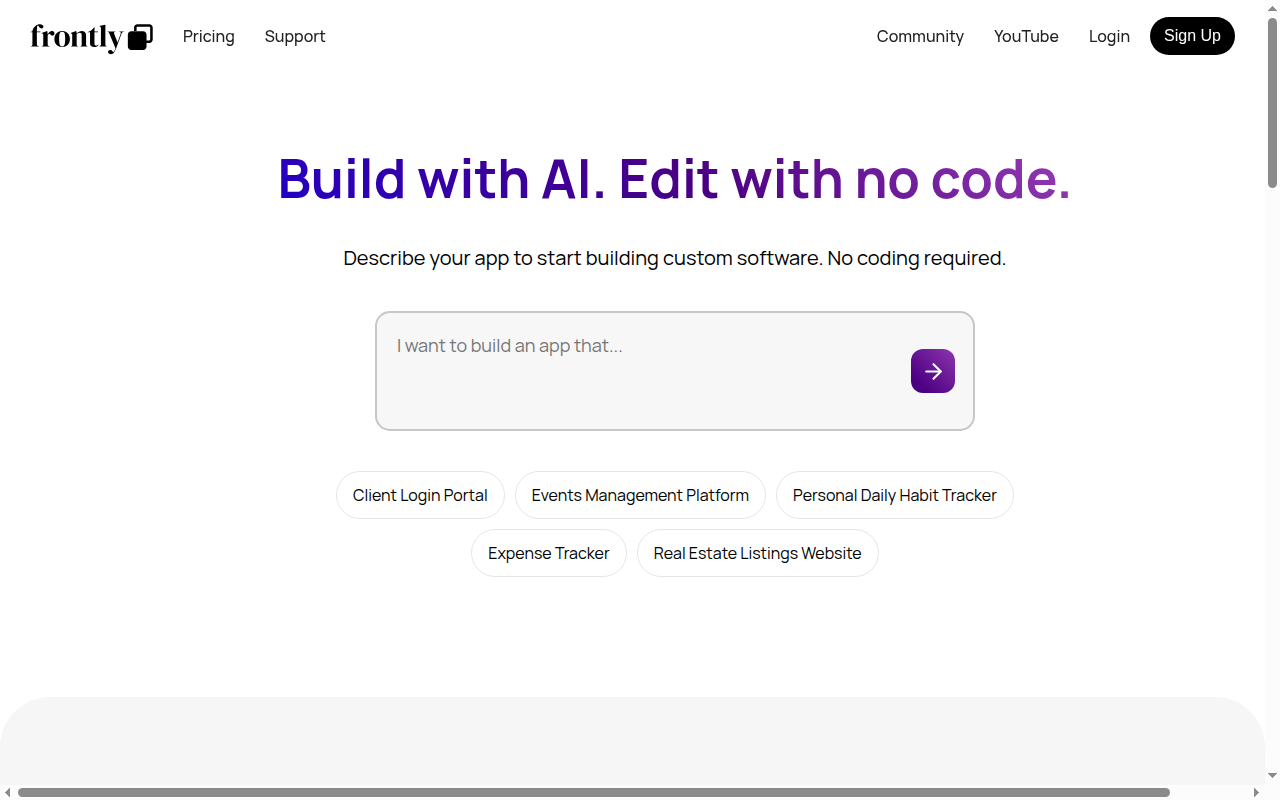
Frontly's public positioning is unusually concrete: custom apps, portals, dashboards, events tools, habit trackers, real-estate listing websites, and other business surfaces show up directly on the homepage. That makes the product feel less like a generic AI coding promise and more like a workflow builder aimed at useful outcomes.
Replit can absolutely build those same categories, but it expects more technical confidence. Frontly is more attractive when the buyer wants results without first becoming comfortable in a coding environment.
Its free tier is generous in the ways non-technical teams care about
Frontly says users can build unlimited apps for free with no time limit, and it also highlights unlimited users on public pricing cards. The hard gates are monthly operations and AI credits rather than project count.
That is important because it changes the buying psychology. A founder or ops lead can experiment with multiple internal tools without feeling like each new app triggers a new software purchase decision.
Visual refinement remains part of the story after generation
Many Replit alternatives promise generation but feel weaker once you need to shape the interface into something specific. Frontly explicitly frames itself as 'Build with AI. Edit with no code,' which suggests the second step is not an afterthought.
That matters for teams who want AI to get the first version done, but still want a visual control layer instead of dropping into raw code for every change.
Known Limitations
- Frontly is not the best fit if your team expects code-first extensibility, branch-heavy developer workflows, or deep engineering ownership from the beginning.
- Its public pricing relies on operations and AI-credit ceilings, which means the apparent simplicity of 'unlimited apps' can hide throughput constraints as usage grows.
- API access only appears on the Professional tier, so more serious integration work starts later than it would in Replit.
- Portability is a weaker story than Replit. Frontly is sold as a managed no-code app platform, not as a developer workspace built around code extraction and custom infrastructure control.
- Help-center materials show product evolution across V1 and V2 experiences, which is healthy, but it also means teams should expect some feature and workflow drift over time.
Who Should Choose Frontly Over Replit?
- Operations-heavy teams that want portals, dashboards, or internal tools without hiring developers first.
- Founders building customer-facing admin surfaces or simple SaaS workflows where visual speed matters more than deep code control.
- Agencies and consultants who need branded business apps quickly and want to avoid turning every small client request into a development task.
- Non-technical builders who like the idea of AI-generated starting points but still want a no-code editing layer after the first draft.
When Replit Is Still the Better Choice
- Stay with Replit if your product roadmap already assumes custom backend logic, serious debugging, or developer-led maintenance.
- Stay with Replit if code ownership and infrastructure clarity are strategic requirements, not nice-to-haves.
- Stay with Replit if your team wants direct API work from the beginning instead of unlocking it on a higher-tier plan.
- Stay with Replit if the app is likely to outgrow no-code constraints and become an engineering product rather than a business workflow surface.
Pricing Comparison & Cost at Scale
Plan overview
- Frontly Starter: Free, unlimited apps, unlimited users, 1,000 monthly operations, 250 AI credits, community support, Frontly branding.
- Frontly Basic: $30/month, 10,000 monthly operations, 1,000 AI credits, team support, 1 custom branded app.
- Frontly Professional: $100/month, 50,000 monthly operations, 5,000 AI credits, priority support, 3 custom branded apps, API access.
- Frontly Enterprise: Custom pricing.
Prices are subject to change. Check the official pricing page for the latest details.
Frontly's cost profile looks attractive at small scale because the free tier is generous and the first paid tier is not extreme. But the real scaling question is operations plus AI credits, not just monthly sticker price.
Replit often feels more expensive upfront for non-technical buyers because it asks for a more developer-shaped workflow. Frontly often feels cheaper at the beginning because it compresses both build and editing into a no-code flow.
If you know your app will remain mostly a workflow, dashboard, or portal, Frontly can be the more efficient spend. If you know your app will become a deeper software product, Replit's technical control can justify the extra complexity.
| Scenario | Frontly | Replit | Notes |
|---|---|---|---|
| First internal tool | Often the better value | More technical overhead | Frontly wins if you mainly need a working ops app. |
| Client portal rollout | Strong fit | Possible, but more build effort | Frontly's portal orientation is a real advantage. |
| Custom product scaling | Costs become about limits and platform fit | Costs become about time, seats, and AI usage | Replit is safer once engineering depth matters. |
Migration, Lock-in, and Team Fit
Frontly's biggest strategic strength is that it lets a small team behave as if it has application-delivery capacity before it really has an engineering bench. That is exactly why it can be a smart Replit alternative for agencies, operators, and business builders.
The mirror image of that strength is lock-in risk. Frontly is selling a managed building surface with branded app allowances, operations caps, and no-code editing ergonomics. That is great when the product remains within the envelope Frontly was designed for. It becomes less comfortable if you later need deep custom code ownership, unusual integration patterns, or an internal team that expects Git-shaped workflows.
In practice, Frontly is best for small teams where the person responsible for the app is closer to operations or product than to software engineering. Replit is best when the person responsible for the app expects to live inside the implementation details, not just the business outcome.
Another useful way to frame the choice is this: Frontly is excellent when the workflow is the product. Replit is excellent when the software itself is the product. If you mix those two ideas up, you risk either overbuying technical complexity or underbuying future control later.
How Frontly Compares to Other Options in Directory 2929
- Compared with Bubble or Softr, Frontly pushes harder on AI-assisted generation while still remaining in no-code territory.
- Compared with Same.new or Lovable, it feels more business-app and portal-oriented than general prompt-to-app experimentation.
- Compared with Replit, it is less flexible for engineers but much friendlier for non-technical teams building operational software.
FAQ
Is Frontly free?
Yes, to start. The public pricing page shows a free Starter plan with unlimited apps and users, but it has monthly operation and AI-credit limits.
Can Frontly replace Replit?
Yes, for some teams. It can replace Replit when the goal is no-code business app delivery, but not when you need a full developer workspace.
How does Frontly compare with Replit for developers?
Replit is better for developers. Frontly is better for non-technical or mixed teams that prioritize visual building and fast business outcomes.
What is Frontly best at?
Portals, dashboards, and internal tools. Those use cases appear repeatedly in its public positioning and fit its no-code editing model well.
Is Frontly good for beginners?
Yes, especially for non-coders. It lowers the barrier dramatically, but buyers still need judgment around operations limits, integrations, and long-term fit.
Does Frontly have strong portability?
Not really. It is a managed no-code platform first, so portability is not its strongest argument in the way it is for more code-centric alternatives.