Hostinger Horizons
Contact
Hostinger Horizons
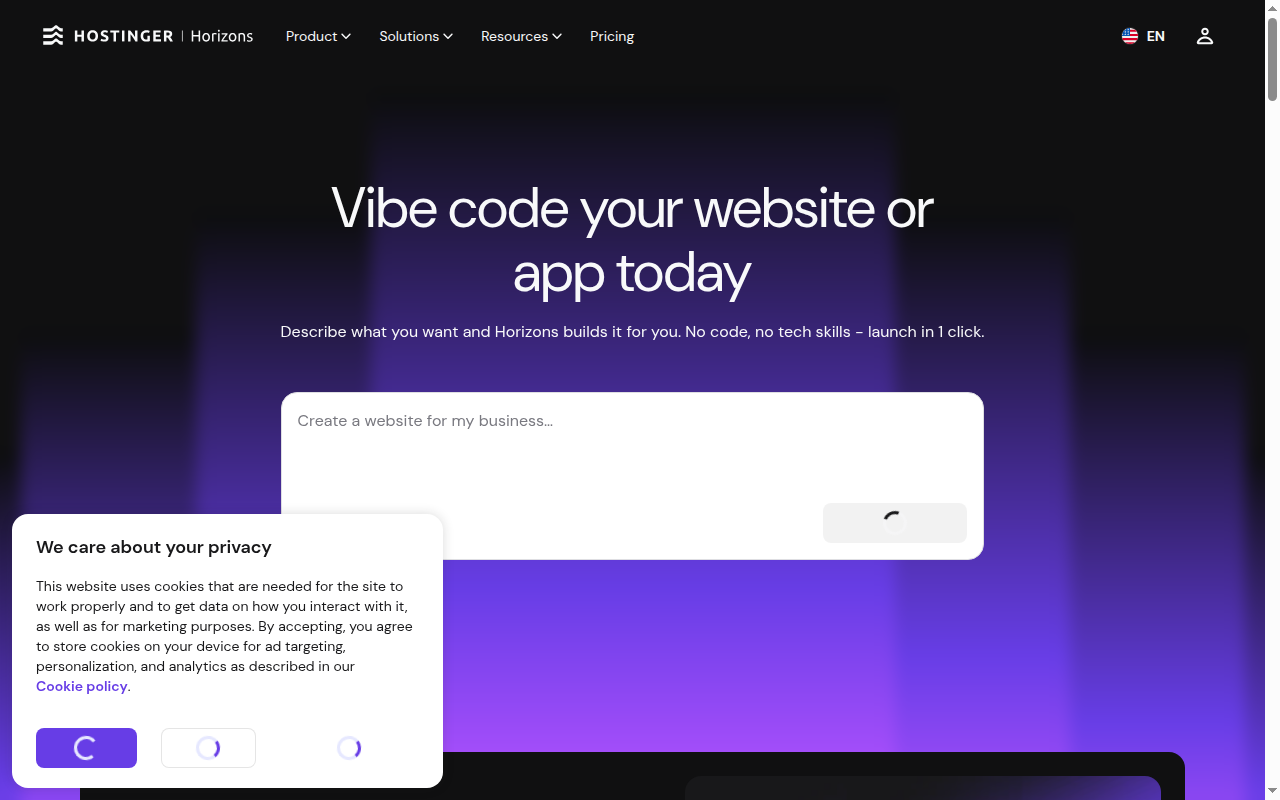
AI web app builder from Hostinger for launching hosted websites and lightweight business apps from prompts.
Hostinger Horizons as a Replit Alternative: Comparison & Decision Guide (2026)
Hostinger Horizons is a reasonable Replit alternative for solo founders and small businesses that want an all-in-one AI builder with hosting included and do not want to assemble a dev stack themselves. Compared with Replit, it trades developer flexibility and deeper app workflows for a simpler vendor-controlled path from prompt to published web app. If you expect to iterate on architecture, use custom engineering workflows heavily, or build more technical products with complex debugging needs, Replit is usually the safer choice.
Hostinger Horizons vs. Replit: Quick Comparison
| Criteria | Hostinger Horizons | Replit |
|---|---|---|
| Primary approach | Prompt-first hosted AI app builder | Browser-based coding workspace with Agent-assisted building |
| Output type | Websites and web apps | Web apps plus a newer mobile app workflow from the web |
| Visual editing | Mostly chat-driven editing; limited compared with dedicated visual builders | Agent plus code-first editing in the workspace |
| Deployment | Integrated into Hostinger infrastructure | Native app publishing and deployment inside Replit |
| Hosting model | Bundled with Hostinger service | Replit-hosted deployments with separate pricing controls |
| Database model | Can integrate backend services; exact default stack depends on the generated app | Built-in SQL database options and storage tools |
| Authentication | Can integrate third-party services; exact defaults are not consistently documented | Replit Auth is documented as a built-in path |
| Code ownership | Paid plans let you download the generated code | You work directly in the codebase inside the workspace |
| Mobile app support | No native iOS or Android app creation according to Hostinger FAQ | Replit now supports a mobile app workflow from the web plus mobile companion apps |
| Git workflow | Not a major selling point in public positioning | Far more natural fit for developer-centric iteration and repo-based work |
| Portability | Better than strict lock-in because code export exists, but infrastructure convenience encourages staying on Hostinger | Usually stronger for ongoing engineering control |
| Collaboration | Best suited to small builder teams and founder-led projects | More mature for collaborative coding workflows |
| Error handling | Heavily dependent on AI chat loops and credit usage | Stronger for manual debugging because you stay close to code and logs |
| Pricing model | Tiered monthly plans with AI credits included | Plan plus credit-based usage around Agent workflows |
| Free plan | No permanent free tier; official positioning centers on paid plans and a trial-style entry | Free daily Agent credits on the pricing page |
| Paid plans | Explorer $6.99, Starter $13.99, Hobbyist $39.99, Hustler $79.99 per month when billed annually | Core starts around $20 per month billed annually or $25 monthly on the current pricing page |
What Hostinger Horizons Does Differently
Hosting, domains, and AI building in one stack: Horizons is designed for people who do not want to think about infrastructure assembly. That matters versus Replit because Replit still feels closer to a coding platform with app publishing, while Horizons is sold as a single-vendor workflow for non-technical launches.
Lower-friction pricing at the entry tier: The official pricing page makes the first paid step cheaper than Replit Core. For very small experiments, that changes the decision because some founders would rather accept a narrower tool if it reduces upfront commitment.
Downloadable code on paid plans: This is important because many hosted AI builders are vague about portability. Horizons explicitly says paid plans let you download the code, which makes it more credible as an MVP launcher than a pure lock-in website generator.
Built for small business use cases more than developer control: Hostinger markets business sites, stores, and lightweight web apps rather than deep engineering workflows. Compared with Replit, that means it can feel easier at the start for a non-technical owner, but also shallower once the product gets more custom.
Known Limitations
- No native mobile app creation: Hostinger's own FAQ says Horizons can build mobile-friendly web apps but not native App Store or Google Play apps. Replit's current product surface is stronger if mobile is part of the roadmap.
- Credit economics can become unpredictable during repair loops: Because building and AI-powered app usage both consume credits, a buggy session can turn into repeated paid prompt cycles faster than many first-time buyers expect.
- Weaker engineering transparency than Replit: Replit keeps you closer to the code, docs, auth, deployment, and runtime behavior. Horizons is easier at first, but when something breaks, the abstraction can become the bottleneck.
- Chat-first editing is a real constraint: Community discussion around Horizons frequently focuses on the friction of making structural edits through prompts instead of direct code-first control.
- Best fit is narrower than the marketing suggests: Horizons is credible for websites, simple customer-facing tools, and lightweight business apps, but it is less convincing for products that need sustained software iteration.
- Hosting convenience creates subtle lock-in: Code export helps, but the whole product is optimized around staying inside Hostinger's environment. Replit is also hosted, but it generally maps more naturally to ongoing developer ownership.
Who Should Choose Hostinger Horizons Over Replit
- Choose Horizons if you are a solo founder who wants one vendor for AI building, hosting, domains, and launch logistics.
- Choose Horizons if your first goal is a simple business web app, internal tool, booking flow, or customer-facing prototype rather than a long-lived engineering product.
- Choose Horizons if you care more about getting a small launch online cheaply than about shaping the internals of the codebase early.
- Choose Horizons if your team is non-technical and would rather tolerate product ceilings than manage developer tooling.
When Replit Is Still the Better Choice
- Stay with Replit if you want a code-first environment that still benefits from AI assistance instead of being trapped inside a prompt-only loop.
- Stay with Replit if mobile apps matter, since Replit now has an explicit mobile workflow while Horizons does not support native app creation.
- Stay with Replit if debugging depth, logs, auth, and database workflows are central to the product you are shipping.
- Stay with Replit if you expect to collaborate with developers who want normal engineering control rather than purely chat-led refinement.
Pricing Comparison & Cost at Scale
Hostinger Horizons currently positions itself with four main paid tiers on the official pricing page: Explorer at $6.99 per month billed annually, Starter at $13.99, Hobbyist at $39.99, and Hustler at $79.99. The same page shows included AI credit pools of 30, 70, 200, and 400 credits per month respectively. It also notes that you can top up credits and that higher plans unlock more advanced workflow features such as a code editor.
That structure looks attractive next to Replit when the only question is entry cost. Replit Core starts materially higher than Horizons Explorer. But the cheaper entry point is not the whole story. Horizons credits are used not only while building but also when AI features inside your live app are used, which means cost predictability depends on both your own iteration behavior and user activity in AI-enabled features.
For a solo founder validating one idea, Horizons can be cost-effective because it bundles hosting and removes setup work. For a small agency or power user iterating across multiple client-style projects, the decision becomes less obvious. Once you move from Explorer or Starter into Hobbyist or Hustler, the price gap versus a developer-centric Replit workflow narrows, while Replit often gives you stronger control over debugging, architecture, and future portability in practice.
The practical takeaway is simple: Horizons is better priced for low-complexity experimentation; Replit is better positioned once complexity, developer involvement, or future refactoring costs dominate the decision.
How Hostinger Horizons Compares to Other Replit Alternatives
Compared with Bolt, v0, and Lovable, Hostinger Horizons is less design-centric and less developer-famous, but stronger as an all-in-one hosted business-builder proposition. Compared with Bubble, Glide, and Softr, it feels more AI-native and faster to start, but usually less structured for long-term app operations. Compared with Replit specifically, its advantage is convenience, not depth.
Decision Summary
If your definition of a Replit alternative is "something cheaper and simpler that can get a lightweight web app online with minimal setup," Hostinger Horizons is a valid option. If your definition is "a platform I can keep growing with as the app becomes more technical," Replit remains the safer long-term bet. Horizons is strongest when convenience is the main buying criterion and weakest when the product starts demanding real software engineering discipline.
FAQ
Is Hostinger Horizons a good Replit alternative?
Yes, for simple launches. It is most compelling for solo founders and small businesses that want an easier, cheaper path to a hosted web app and do not need Replit's deeper developer workflow.
Can Hostinger Horizons build native mobile apps?
No, not currently. Hostinger's FAQ says Horizons builds mobile-friendly websites and web apps, but not native App Store or Google Play apps.
Do you own the code made with Hostinger Horizons?
Yes, on paid plans. Hostinger says paid Horizons plans let you download the code of your site or web app.
Is Hostinger Horizons cheaper than Replit?
Usually at entry level. Horizons starts below Replit Core, but total cost depends on how many AI credits you burn during building and inside live AI features.
When should you avoid Hostinger Horizons?
Avoid it for complex products. If you expect deeper debugging, frequent architectural changes, or a serious mobile roadmap, Replit is a better fit.