
Lovable
AI-powered full-stack web application builder using natural language prompts and chat interface.
Lovable - Replit alternative
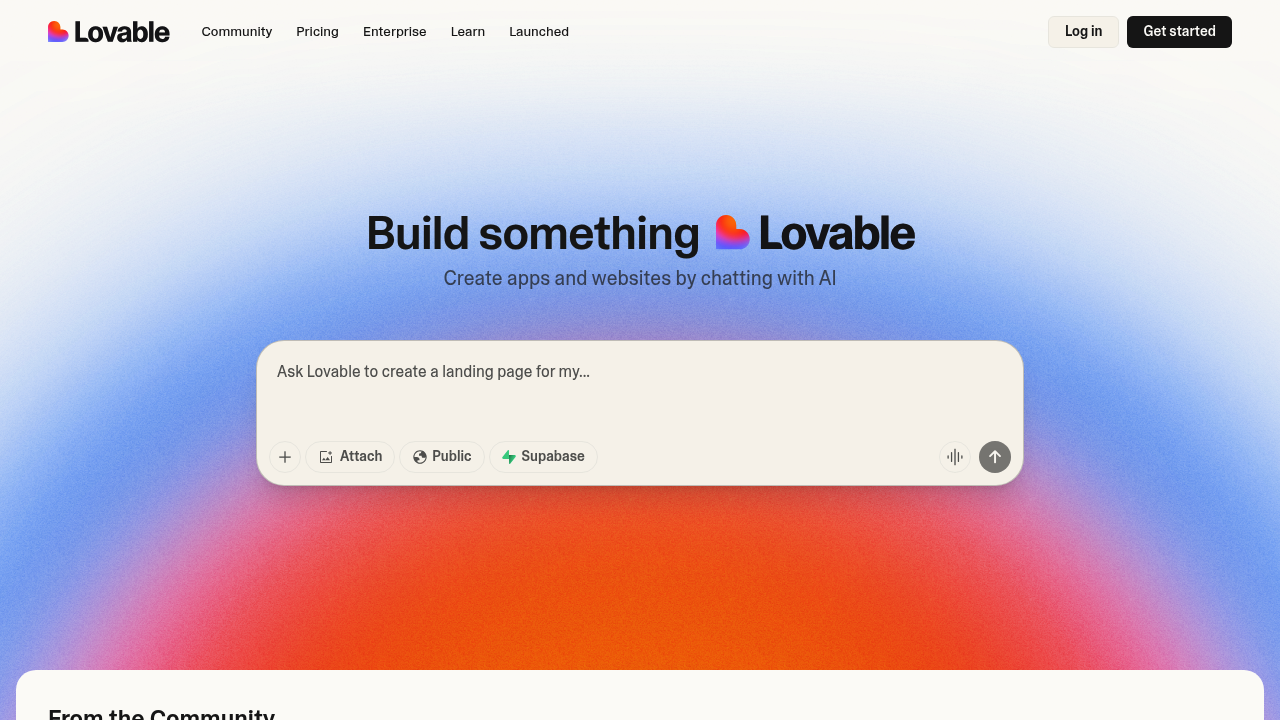
Lovable is a chat-based development platform that generates production-ready web applications from text descriptions. Users describe features in plain English, and the AI generates complete front-end code with integrated backend capabilities. The platform connects natively with Supabase for PostgreSQL databases and GitHub for version control. Solo developers benefit from building functional prototypes without writing boilerplate code, focusing instead on product logic and iteration speed.
Strengths
- Native database integration — Supabase connection provides PostgreSQL database, authentication, real-time features, and file storage through chat commands without manual configuration.
- Two-way GitHub sync — Automatic commits to default branch enable seamless transitions between Lovable chat interface and traditional IDE workflows.
- Credit-based pricing transparency — Simple edits (styling changes) consume 0.5 credits while complex features (authentication systems) use 1.2 credits, making costs predictable.
- Multi-model AI support — Users can switch between Anthropic Claude, OpenAI GPT-4, and Google Gemini models to optimize for different design and coding tasks.
- Multiplayer collaboration — Workspace-based architecture allows up to 20 team members to edit projects simultaneously using shared credit pools.
- Dev Mode code access — Direct code editing within Lovable interface provides escape hatch for developers needing granular control over generated output.
Weaknesses
- Credit system requires planning — Monthly credit allocations do not automatically scale with usage spikes; exceeding limits requires manual plan upgrades or waiting for reset.
- Cloud-only execution — No local development environment option; all building and testing happens in Lovable's hosted infrastructure.
- Front-end focus — Platform primarily generates React-based UI code; complex backend logic beyond Supabase capabilities requires external services.
- Free tier limitations — 5 daily credits (30 monthly) restrict meaningful prototyping; projects remain public with up to 20 collaborators.
Best for
Solo developers and small teams building web applications who prioritize rapid prototyping over manual coding. Suitable for founders validating SaaS ideas, designers creating interactive mockups, and developers needing production-ready starter code.
Pricing plans
- Free — $0/month — 5 daily credits (30/month maximum), public projects only, 20 collaborators per project
- Pro 1 — $25/month or $21/month annual — 100 monthly credits, 5 daily credits (150/month maximum), private projects, custom domains, credit rollovers
- Pro 2 — $50/month or $42/month annual — 200 monthly credits, same features as Pro 1
- Pro 3 — $100/month or $84/month annual — 400 monthly credits, same features as Pro 1
- Pro 4 — $200/month or $167/month annual — 800 monthly credits, same features as Pro 1
- Pro 5 — $294/month or $246/month annual — 1,200 monthly credits, same features as Pro 1
- Pro 6 — $480/month or $404/month annual — 2,000 monthly credits, same features as Pro 1
- Pro 7 — $705/month or $595/month annual — 3,000 monthly credits, same features as Pro 1
- Pro 8 — $920/month or $779/month annual — 4,000 monthly credits, same features as Pro 1
- Pro 9 — $1,125/month or $957/month annual — 5,000 monthly credits, same features as Pro 1
- Pro 10 — $1,688/month or $1,403/month annual — 7,500 monthly credits, same features as Pro 1
- Pro 11 — $2,250/month or $1,828/month annual — 10,000 monthly credits, same features as Pro 1
- Business 1 — $50/month or $42/month annual — 100 monthly credits, adds SSO, personal projects, opt-out data training, design templates
- Business 2 — $100/month or $84/month annual — 200 monthly credits, same Business features
- Business 3 — $200/month or $167/month annual — 400 monthly credits, same Business features
- Business 4 — $400/month or $334/month annual — 800 monthly credits, same Business features
- Business 5 — $588/month or $396/month annual — 1,200 monthly credits, same Business features
- Business 6 — $960/month or $653/month annual — 2,000 monthly credits, same Business features
- Business 7 — $1,410/month or $969/month annual — 3,000 monthly credits, same Business features
- Business 8 — $1,840/month or $1,276/month annual — 4,000 monthly credits, same Business features
- Business 9 — $2,250/month or $1,575/month annual — 5,000 monthly credits, same Business features
- Business 10 — $3,300/month or $2,310/month annual — 7,500 monthly credits, same Business features
- Business 11 — $4,300/month or $3,010/month annual — 10,000 monthly credits, same Business features
- Enterprise — Custom pricing — Unlimited credits negotiated, dedicated support, onboarding services, custom integrations, group-based access control, custom design systems
Tech details
- Type: Cloud-hosted AI code generation platform
- IDEs: Web-based chat interface, Dev Mode for in-platform code editing, two-way GitHub integration for external IDE access
- Key features: Natural language to React code generation, Supabase PostgreSQL integration, real-time database subscriptions, authentication systems, file storage, visual style editor, security vulnerability scanning, custom domain management, Chat Mode Agent for debugging without code edits
- Privacy / hosting: Cloud-hosted on Lovable infrastructure; Business plans offer opt-out from AI model training; no self-hosted or local development options available
- Models / context window: Anthropic Claude (200,000 tokens), OpenAI GPT-4, Google Gemini available; users select model per project or prompt
When to choose this over Replit
- You need integrated PostgreSQL database and authentication without infrastructure setup; Lovable's Supabase connection provides production backend through chat commands.
- Your workflow prioritizes natural language iteration over manual coding; describing features generates working implementations faster than writing from scratch.
- Project requires front-end focus with modern React stack; Lovable generates production-ready UI code with responsive design and component architecture.
When Replit may be a better fit
- Your project requires polyglot support beyond web technologies; Replit supports 50+ languages including Python, Java, C++, and Go for backend services.
- Team needs collaborative code editing with live cursor tracking; Replit provides IDE-style multiplayer coding rather than chat-based generation.
- Budget requires predictable flat-rate pricing; Replit offers unlimited cycles at fixed monthly cost versus Lovable's consumption-based credit system.
Conclusion
Lovable transforms web application development into a conversational workflow. The platform excels at rapid prototyping for solo developers and small teams building React-based applications. Native Supabase integration eliminates backend configuration overhead, while GitHub sync preserves traditional development workflows. The credit-based pricing model suits predictable workloads but requires capacity planning for intensive development periods. This Replit alternative works best for founders validating product ideas and developers prioritizing speed over infrastructure control.
Sources
- Official site: https://lovable.dev/
- Docs: https://docs.lovable.dev/introduction/plans-and-credits
- Pricing: https://lovable.dev/pricing
FAQ
What is the difference between Lovable credits and Replit cycles?
Lovable credits measure AI generation work; simple styling changes consume 0.5 credits while authentication features use 1.2 credits. Replit cycles represent compute resources for code execution and hosting. Lovable charges per code generation request, Replit charges per infrastructure usage.
Can I export my Lovable project to run locally?
Yes, through GitHub integration. Lovable automatically commits all code changes to your connected GitHub repository. You can clone the repository and run the React application locally using standard npm commands. The code remains accessible outside Lovable's platform.
How does Lovable handle database migrations compared to Replit?
Lovable generates SQL scripts for Supabase schema changes through chat prompts. Users copy the SQL and execute it in Supabase dashboard. Replit requires manual database setup and migration scripts. Lovable automates schema generation but delegates execution to Supabase; Replit provides direct database access.
Does Lovable support backend API development like Replit?
Limited support. Lovable focuses on front-end React code generation with Supabase backend integration. Complex API logic, custom server code, or non-JavaScript backends require external services. Replit provides full-stack development environments for any language and framework combination.
What happens when I run out of Lovable credits mid-project?
Development pauses until credit reset (daily or monthly) or manual plan upgrade. Free tier provides 5 daily credits that reset every 24 hours. Paid plans receive monthly allocations with optional credit rollovers. No automatic top-ups exist; users must upgrade subscription tier for additional capacity.
Can multiple developers work on the same Lovable project simultaneously?
Yes, with workspace plans. Pro plans support personal workspaces with up to 2 project collaborators who share owner's credits. Business plans provide team workspaces for up to 20 users with shared credit pool. All workspace members can edit projects in real-time using the chat interface.