
Momen
Contact
Momen
AI-assisted no-code web app builder for founders who want a visual builder, built-in database logic, and a production path that can keep scaling after the MVP stage.
Momen as a Replit Alternative: Comparison & Decision Guide (2026)
Momen is a credible Replit alternative for non-technical founders and small product teams that want to ship a production-ready web app without starting inside a coding IDE. It gives you a more visual, guided building model than Replit, but it also asks you to accept a more opinionated no-code platform with add-on based pricing.
Compared with Replit, Momen is less about coding in the browser and more about designing an app, wiring logic, managing data, and publishing a production web product with fewer engineering decisions up front. That can be a better fit when the blocker is shipping the first real app, not owning every low-level implementation step from day one.
It is a weaker choice if your team already thinks in repositories, custom runtimes, or language-level flexibility. Momen's public positioning is strongest for web-app builders who want speed, visual control, and platform help, not for developers who want Replit's broader coding surface and agent-assisted IDE workflow.
Momen vs. Replit: Quick Comparison
| Decision area | Momen | Replit |
|---|---|---|
| Primary approach | Visual no-code web app builder with AI-assisted setup and workflows | Browser-based coding environment with AI help and hosted runtimes |
| Best fit | Non-technical founders, operators, and web-app teams that want guided production building | Developers and technical builders who still want to work close to code |
| Output type | Production-ready web apps | General coding projects, apps, agents, websites, and runtime experiments |
| Visual editing | Yes, the homepage positions it like designing in Figma | Limited compared with a dedicated visual builder |
| Database model | Built-in database with tables, fields, and relationships | Replit-managed stack options, but the public product story is less database-first |
| Automation logic | Visual triggers, flows, actions, and AI workflows | More code-centric and agent-centric than visual-flow centric |
| Authentication | Not clearly documented in the fetched public pages as a flagship differentiator | Commonly part of broader app-building flows, but not the main purchase story |
| Payments | Stripe activation is explicitly mentioned on the homepage | Possible, but not positioned as a built-in no-code business workflow |
| Scalability claim | Homepage claims support for up to 1 million daily active users | Replit can scale projects, but the fetched public narrative is broader and less founder-funnel specific |
| Debugging / observability | Searchable logs are explicitly highlighted | Developer debugging is stronger overall, but the flow is more code-native |
| Code extensibility | React components, JavaScript logic, and a GraphQL API are mentioned | Much broader coding flexibility across stacks and languages |
| Portability | Start with no code and gain more control, but full code export is not publicly documented | Generally better when you want a coding-first environment rather than a managed builder |
| Mobile support | Not publicly documented on the fetched homepage and pricing pages | Possible through coding, but not a mobile-first visual-builder story |
| Pricing model | Per-project subscription plus add-ons for storage, outbound data, Actionflow runs, and AI points | Subscription and usage tradeoffs, but usually less builder-platform style add-on billing |
| Free plan | Yes | Yes |
| Paid entry point | $33 per project per month billed annually for Basic | Replit's public pricing is easier for coding seats, but Momen is priced around a managed app platform |
What Momen Does Differently
It treats app structure as a visual product problem first
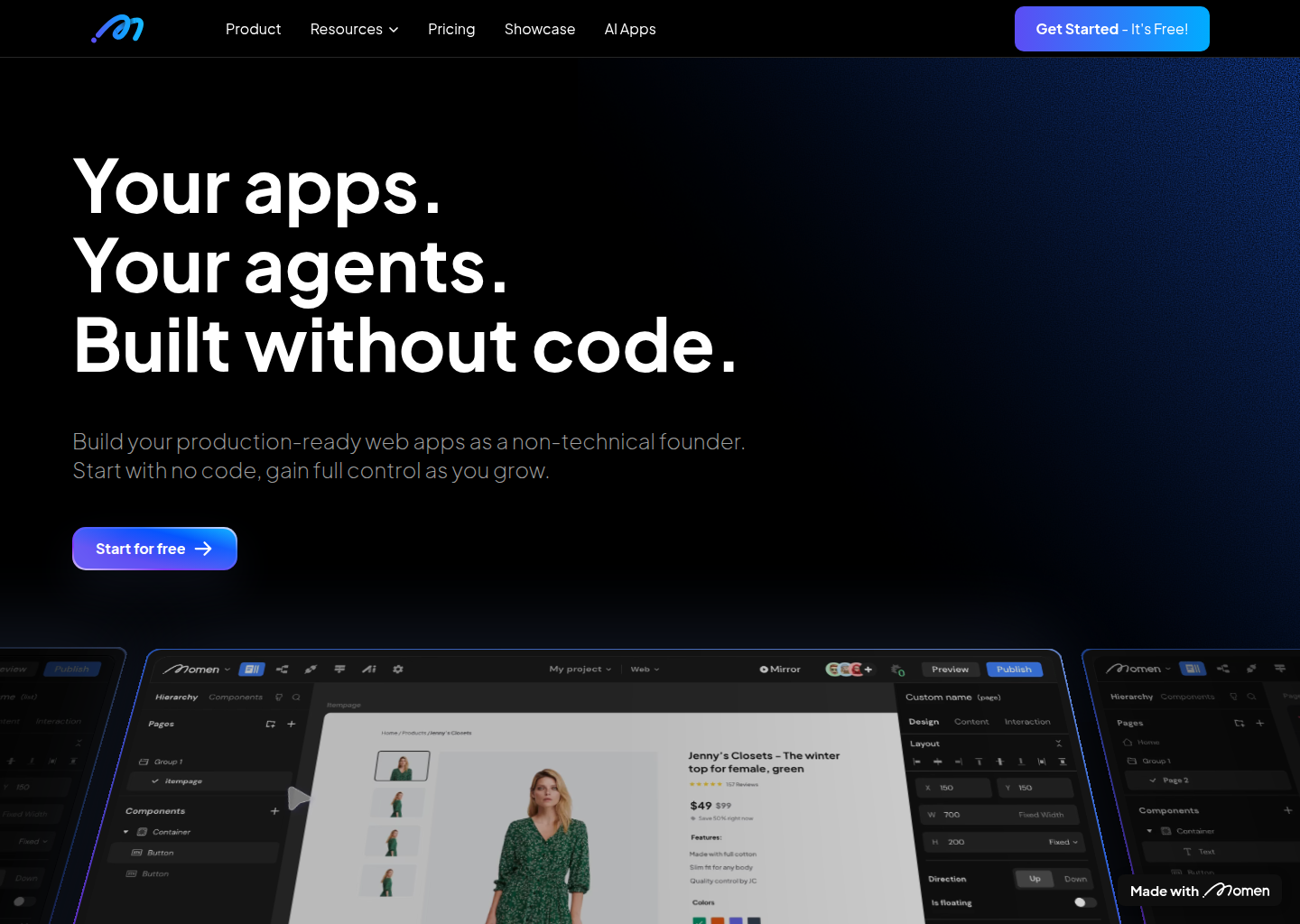
Momen is much closer to a business-app platform than to a coding IDE. The official homepage leads with visual design, built-in database setup, logic flows, previewing, and one-click publishing rather than code generation as the main experience.
That matters if your Replit alternative search is really about getting a founder or operator to a live web product without immediately becoming the engineering team. In that scenario, Momen's opinionated structure can reduce the number of early architectural choices that slow non-technical teams down.
The pricing model is built around an app platform, not just an AI assistant
Momen's public pricing is per project, then extends through add-ons for storage, outbound transfer, Actionflow runs, and AI points. That is a different buying model from a tool you mainly evaluate as a coding companion.
The upside is clearer app-platform thinking: you can reason about the cost of a product, not just the cost of prompts. The downside is that the total bill becomes more sensitive to growth, automation volume, and infrastructure usage than many buyers first expect.
It is stronger than Replit for a no-code founder workflow, but weaker for code-native freedom
Momen explicitly targets non-technical founders and promises that they can start without code and gain control later. That positioning is narrower than Replit's, but it is also easier to understand if the job is building a web app for real users rather than learning a development environment.
The tradeoff is that Replit still makes more sense when the team wants broad language choice, repo-shaped engineering habits, and fewer platform assumptions. Momen wins by constraining the workflow; Replit wins by leaving more of the workflow open.
Known Limitations
- The official public pages are much stronger on web-app building than on broader software flexibility, so Momen is a narrower Replit alternative than the search term may initially suggest.
- The pricing model can become harder to forecast at scale because subscriptions are only part of the bill. Add-ons for storage, outbound data, Actionflow runs, and AI points create a second layer of cost that founders need to model honestly.
- Full portability is not as clear as it is in a code-first environment. Momen clearly exposes React components, JavaScript logic, and a GraphQL API, but a full export-and-leave story is not publicly documented on the fetched sources.
- Mobile output is not publicly documented in the fetched official pages, so buyers looking for a true Replit alternative across both web and native mobile should not assume that capability is covered.
- Teams with established repositories, testing pipelines, and engineering review habits may find the visual-builder center of gravity restrictive once the product moves past the first big shipping phase.
Who Should Choose Momen Over Replit?
- Choose Momen over Replit if you are a non-technical founder who wants to launch a real web app without starting from a coding environment.
- Choose it if your product is fundamentally a database-backed business app and you care more about visual building, logic flows, and deployment speed than about language-level flexibility.
- Choose it if you want pricing that maps to a managed app platform and you are comfortable forecasting add-ons as the product grows.
- Choose it if you want a founder-friendly workflow where design, data, automation, and publishing stay in one opinionated surface.
When Replit Is Still the Better Choice
- Stay with Replit if your team wants a coding-first environment where code, runtime choice, and agent-assisted engineering remain the center of truth.
- Stay with Replit if portability, repository habits, and lower platform dependence matter more than guided no-code delivery.
- Stay with Replit if your project needs broader software experimentation than a focused web-app builder naturally supports.
- Stay with Replit if your engineering team already knows how to build quickly and the real need is acceleration, not a more opinionated product platform.
Pricing Comparison & Cost at Scale
Plan overview
- Free: $0 for building and exploring app ideas.
- Basic: $33 per project per month billed annually.
- Pro: $85 per project per month billed annually.
- Enterprise: custom pricing.
Prices can change. Check the official pricing pages before making a buying decision.
| Scenario | Momen | Replit | Notes |
|---|---|---|---|
| Solo founder validating one idea | Free or Basic can be enough if usage stays modest | Replit may be simpler if the founder is technical | Momen wins when the founder wants less code and more guided structure. |
| Small business launching one production web app | Basic can work, but add-ons can change the bill | Replit requires more technical ownership | Momen's price can still be rational if it removes external builder and backend setup work. |
| Growing app with automation and live users | Pro plus storage, transfer, Actionflow, and AI point add-ons | Replit may be cheaper or more flexible depending on build style | This is where Momen's usage-based platform economics need active monitoring. |
| Team that wants many products or custom control | Enterprise discussion likely required | Replit stays attractive for code-centric teams | Once multiple products or heavier engineering governance appear, Replit often becomes the easier long-run home. |
Pricing risk notes
- Momen's official pricing is honest about add-ons, which is good, but it also means the sticker price is not the whole operating cost.
- The riskiest line items are AI points and Actionflow runs because both can grow quietly if the product becomes more automated or if usage patterns change.
- The public plan labels are annual for the priced tiers shown in the fetched page. Monthly-equivalent comparisons should be treated as approximate unless the official page says otherwise.
How This Tool Compares to Other Options in Directory 2929
- Compared with Bubble, Momen feels more AI-assisted and founder-guided, but Bubble still has a deeper long-term ecosystem and a more familiar reputation for complex no-code web products.
- Compared with Softr, Momen appears more ambitious on app logic, AI workflows, and product extensibility, while Softr usually feels simpler for lighter portals and internal tools.
- Compared with CatDoes, Momen is more web-app and business-logic oriented, while CatDoes is stronger when the buyer wants mobile output and app-store pathways from the same product surface.
FAQ
Is Momen free?
Yes. Momen has a free plan on the official pricing page, but meaningful production usage usually moves toward the paid per-project tiers.
Can Momen replace Replit?
Sometimes. It can replace Replit for founder-led web-app building, but not for every code-first engineering workflow Replit supports.
What is Momen's key workflow advantage?
Its main advantage is visual app building with built-in data, logic, and deployment in one founder-friendly product surface.
Is Momen good for beginners?
Yes for non-technical web-app beginners, because the official workflow is much more guided than a coding environment.
Does Momen export code?
Not publicly documented in the fetched official pages. The product clearly supports React components, JavaScript logic, and a GraphQL API, but a full export story is not spelled out here.
What is the biggest pricing risk?
The biggest risk is assuming the subscription is the whole cost. Storage, transfer, Actionflow runs, and AI points can all push the bill higher as the app grows.