
NxCode
Contact
NxCode
Dual-agent AI development platform (Conductor + Virtuoso) with real Docker execution and Cloudflare edge deployment.
NxCode as a Replit Alternative: Comparison & Decision Guide (2026)
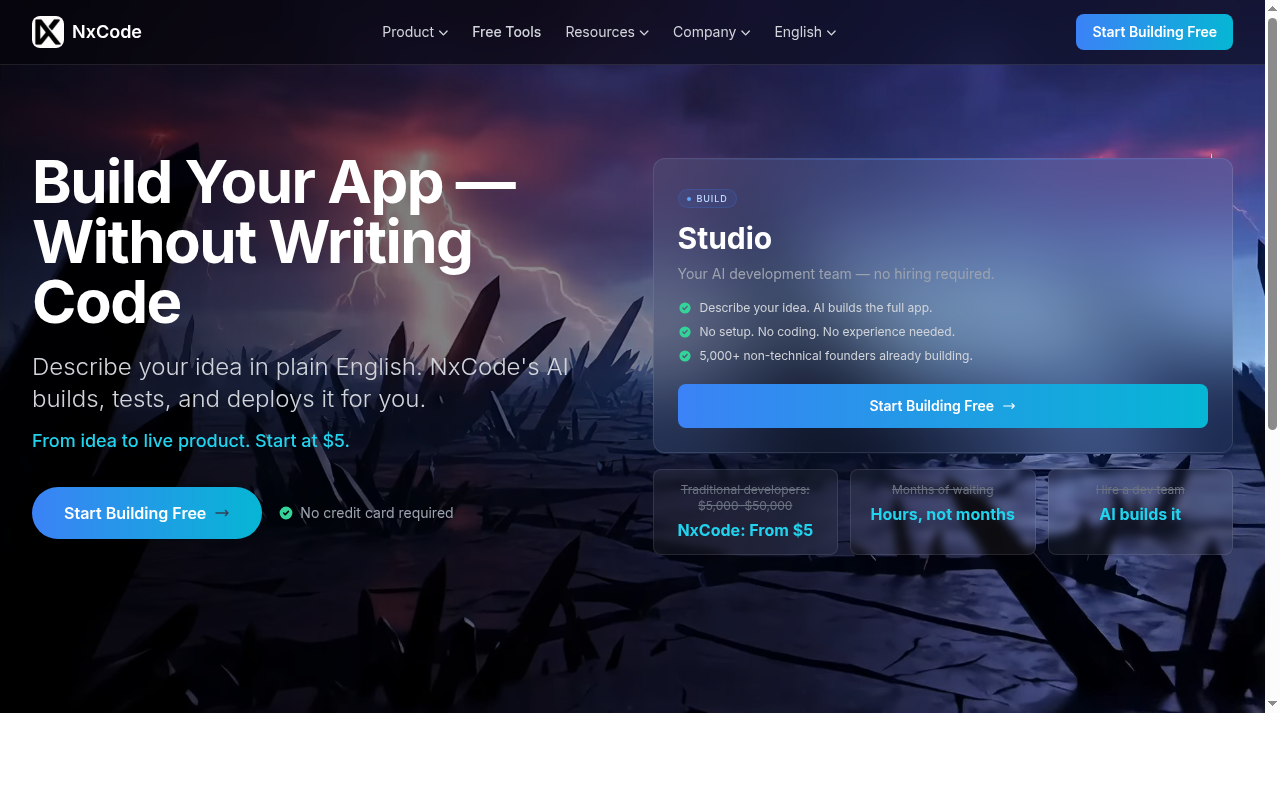
NxCode is a dual-agent AI development platform that combines a Conductor agent (planning, architecture) and a Virtuoso agent (execution, code writing) with real Docker execution environments — making it a technically serious Replit alternative for developers who want more controlled, containerized AI-assisted development. Where Replit is an all-in-one browser IDE with AI assist bolted on, NxCode is designed around structured AI workflows with Acceptance Criteria-driven development and automated error detection.
The tradeoff: you gain a more deliberate, multi-agent architecture with real compute isolation and an interesting 70% revenue share marketplace model. You lose Replit's breadth, its mobile-free simplicity, and its established user base and ecosystem.
NxCode is not a fit for non-developers or teams looking for no-code or visual building — it's built for developers who want AI to be a serious coding partner rather than a suggestion engine.
NxCode vs. Replit: Quick Comparison
| Decision area | NxCode | Replit |
|---|---|---|
| Primary approach | Dual-agent AI (Conductor + Virtuoso) for structured development | Browser IDE with AI assist (Ghostwriter) and web deployment |
| Output stack | General-purpose code; Cloudflare edge deployment | Web, backend, scripts — any language |
| AI capability | Dual agent: planning (Conductor) + execution (Virtuoso), Acceptance Criteria-driven | Ghostwriter — code completion, generation, chat |
| Visual editing | Not publicly documented | Minimal — code-first, no visual drag-and-drop |
| Figma import | Not publicly documented | Not supported |
| Deployment | Cloudflare edge deployment | Replit-hosted deployments; custom domains on paid plans |
| Database | Not publicly documented | Replit DB (key-value); PostgreSQL via add-ons |
| Authentication | Not publicly documented | Not built-in; via third-party libraries |
| Mobile support | Not publicly documented | No native mobile app publishing |
| Git/GitHub workflow | Not publicly documented | GitHub import/export supported |
| Code export / portability | Code-first platform; portability expected but not fully documented | Full code access; can export and self-host |
| Collaboration | Not publicly documented | Real-time multiplayer collaboration in IDE |
| Error handling / debugging | Auto error detection built into agent pipeline | Built-in debugger, console, error highlighting |
| Pricing model | Free, credit-based paid tiers | Free + Core $25/mo + Teams from $40/mo |
| Free plan | Yes — free tier available | Yes — limited compute, public Repls only |
| Paid plans | Lite $5/mo (200 credits), Pro $20/mo (1500 credits), Enterprise custom | Core $25/mo; Teams $40+/mo |
What NxCode Does Differently
Dual-Agent Architecture for Structured AI Development
NxCode's key architectural bet is separating planning from execution: the Conductor agent handles architecture decisions and task decomposition, while the Virtuoso agent executes the actual code writing. This is a different model from Replit's single Ghostwriter AI, which handles both assistance functions simultaneously.
The practical difference: for complex multi-step projects, the dual-agent approach can produce more internally consistent output because planning and implementation are handled by specialized agents rather than a single general-purpose model. Whether this translates to significantly better outcomes vs. Replit's approach depends heavily on the complexity of your project.
Acceptance Criteria-Driven Development
NxCode is built around Acceptance Criteria as the primary input for the AI agents — you define what the output should satisfy, and the agents work toward those criteria with automated error detection. Replit's AI assist is more reactive: it helps you write code as you work, but doesn't verify output against predefined success conditions.
This matters for developers building features with clear success metrics (e.g., "this endpoint returns X given Y input"). It's less relevant for exploratory prototyping, where Replit's lighter-touch assistance model may actually be faster.
Real Docker Execution and Cloudflare Edge Deployment
NxCode uses real Docker containers for execution — not Replit's custom container system — which offers more predictable compute isolation for developers who care about environment consistency. Combined with Cloudflare edge deployment, this positions NxCode for projects where edge performance matters.
Replit's deployment infrastructure is proprietary and less transparent about underlying compute. For teams that want to know exactly what their code is running in, Docker-backed execution is a meaningful difference.
70% Revenue Share Marketplace
NxCode offers a marketplace where developers can share or sell agents and workflows, with a 70% revenue share to creators. This is an unusual model for a developer tool and has no equivalent in Replit's current offering. For developers who want to monetize reusable AI workflows or agent configurations, this opens a commercial dimension Replit doesn't provide.
Known Limitations
- Credit-based pricing risk: NxCode's paid tiers (200 credits at $5/mo, 1500 credits at $20/mo) introduce usage-based cost uncertainty. If a complex project consumes credits faster than expected, costs can escalate or work stops until the next billing cycle. Replit's seat-based pricing is more predictable for heavy users.
- Limited public documentation: Many key areas — database, auth, mobile support, GitHub workflow, collaboration — are not publicly documented. This makes NxCode harder to evaluate against Replit for specific use cases without hands-on testing.
- Collaboration not documented: Replit has well-established real-time multiplayer collaboration. NxCode's collaboration model is not publicly documented, making it a risky choice for multi-person teams who need shared development workflows.
- Smaller ecosystem and community: Replit has a large active user community, templates, educational resources, and a history of community projects. NxCode is newer with a much smaller publicly visible community, which matters for onboarding and troubleshooting.
- No visual editing or no-code path: If any team member is non-technical or design-focused, NxCode offers no visual layer. Replit is also code-first, but its broader ecosystem has more on-ramps for mixed technical/non-technical teams.
Who Should Choose NxCode Over Replit?
- Developers who want structured AI-driven development: If you're working on projects with clear Acceptance Criteria and want the AI to own planning separately from execution, NxCode's dual-agent model offers a different — and potentially more disciplined — development loop than Replit's Ghostwriter.
- Teams deploying to Cloudflare edge: If your production architecture uses Cloudflare Workers or Pages, NxCode's native Cloudflare edge deployment path removes a deployment integration step that Replit would require you to configure separately.
- Developers building and monetizing reusable AI workflows: The 70% revenue share marketplace is unique. If you're building reusable agent workflows that others might pay for, NxCode creates a commercial opportunity Replit doesn't.
- Projects requiring Docker-consistent execution environments: Real Docker execution is more predictable for environment-sensitive workloads. Developers who've been burned by container inconsistency in other platforms may find NxCode's infrastructure more trustworthy.
When Replit Is Still the Better Choice
- You want predictable monthly costs: Replit's seat-based pricing ($25/mo Core) is straightforward. NxCode's credit system introduces spend uncertainty for heavier projects.
- You need real-time collaboration: Replit's multiplayer IDE is a production feature with broad documentation. NxCode's collaboration story is unknown.
- You're onboarding a non-technical team member: Replit has templates, tutorials, and an established community. NxCode is a more specialized, less documented platform for exploratory onboarding.
- You need GitHub integration: Replit supports GitHub import/export. NxCode's Git workflow is not publicly documented — a gap for teams that live in GitHub.
- You need a broad language runtime: Replit supports dozens of languages with pre-configured environments. NxCode's language breadth is not fully documented.
Pricing Comparison & Cost at Scale
NxCode Plan Overview
- Free: Available; credit limits not fully documented
- Lite: $5/mo — 200 credits
- Pro: $20/mo — 1500 credits
- Enterprise: Custom pricing
Replit Plan Overview
- Free: Public Repls, limited compute
- Core: $25/mo per user
- Teams: From $40/mo per user
| Scenario | NxCode | Replit | Notes |
|---|---|---|---|
| Solo developer, light use | $5/mo (Lite, 200 credits) | Free or $25/mo Core | NxCode cheaper if light usage; Replit more predictable |
| Solo developer, heavy AI use | $20/mo (Pro, 1500 credits) — may run out | $25/mo Core (compute-based, not credit-capped) | Credit exhaustion risk on NxCode; Replit more stable |
| 3-person team | Not publicly documented per-seat model | $75+/mo (3x Core) or Teams pricing | NxCode team pricing unknown — evaluate carefully |
Prices are subject to change. Check official pricing pages for the latest details. NxCode's credit model means high-intensity sessions may exhaust your monthly allowance faster than expected.
How NxCode Compares to Other Options
- vs. Replit Agent: Replit has added more agentic features to its product. NxCode's dual-agent architecture is more explicitly structured, but Replit has a much larger installed base and more documented reliability. For developers evaluating pure AI agency, both are worth testing.
- vs. Cursor: Cursor is a VS Code fork with AI assist — it's a local IDE, not a cloud builder. NxCode is cloud-based with deployment included. If you want to stay in a local environment with more control, Cursor is more relevant. If you want cloud-native AI development, NxCode is closer to the right category.
- vs. Lovable: Lovable is AI-first and produces full-stack web apps in a more no-code style. NxCode is more developer-oriented with a structured agent workflow. If you want faster visual output with less configuration, Lovable may win; if you want the structured dual-agent model, NxCode is distinctive.
FAQ
Is NxCode free?
Yes, NxCode offers a free tier. Paid plans start at $5/month (Lite, 200 credits) and $20/month (Pro, 1500 credits). Enterprise pricing is custom. Credit limits on the free tier are not fully documented — test it before relying on it for production work.
Can NxCode replace Replit?
Partially, for developers who want structured AI-driven development with Docker execution. NxCode cannot fully replace Replit's breadth: it lacks documented collaboration, GitHub integration, and broad language runtime support. For specific workflows (edge deployment, dual-agent planning), it may be preferable; for general-purpose use, Replit is more versatile.
What makes NxCode's dual-agent approach different?
The Conductor agent handles architecture and planning; the Virtuoso agent executes code. This separation means complex projects are approached with more deliberate task decomposition rather than a single AI assistant handling everything simultaneously. Acceptance Criteria drive the agents' success targets, with auto error detection validating output.
Is NxCode good for non-developers?
No. NxCode is designed for developers. It has no documented visual editor, no-code path, or beginner-oriented onboarding. Non-technical users building apps would be better served by Glide, Softr, or Adalo.
What is the revenue share marketplace?
NxCode offers a marketplace where developers can sell or share agent configurations and workflows, retaining 70% of revenue. This is a unique commercial model in the developer tools space. Details on marketplace content types, payment processing, and availability are not fully documented beyond the core concept.