
OnSpace AI
Contact
OnSpace AI
AI no-code app builder for web and mobile apps with managed backend, auth, and deployment.
OnSpace AI as a Replit Alternative: Comparison & Decision Guide (2026)
OnSpace AI is a good Replit alternative for founders and non-technical builders who want to generate and ship web or mobile apps with managed backend infrastructure instead of working inside a coding-first environment. It is stronger than Replit when the buyer wants the platform to handle more of the app-building burden through prompts, credits, and integrated services. It is weaker than Replit when the buyer needs code-centric workflows, lower abstraction, or long-term software stewardship with less platform dependency.
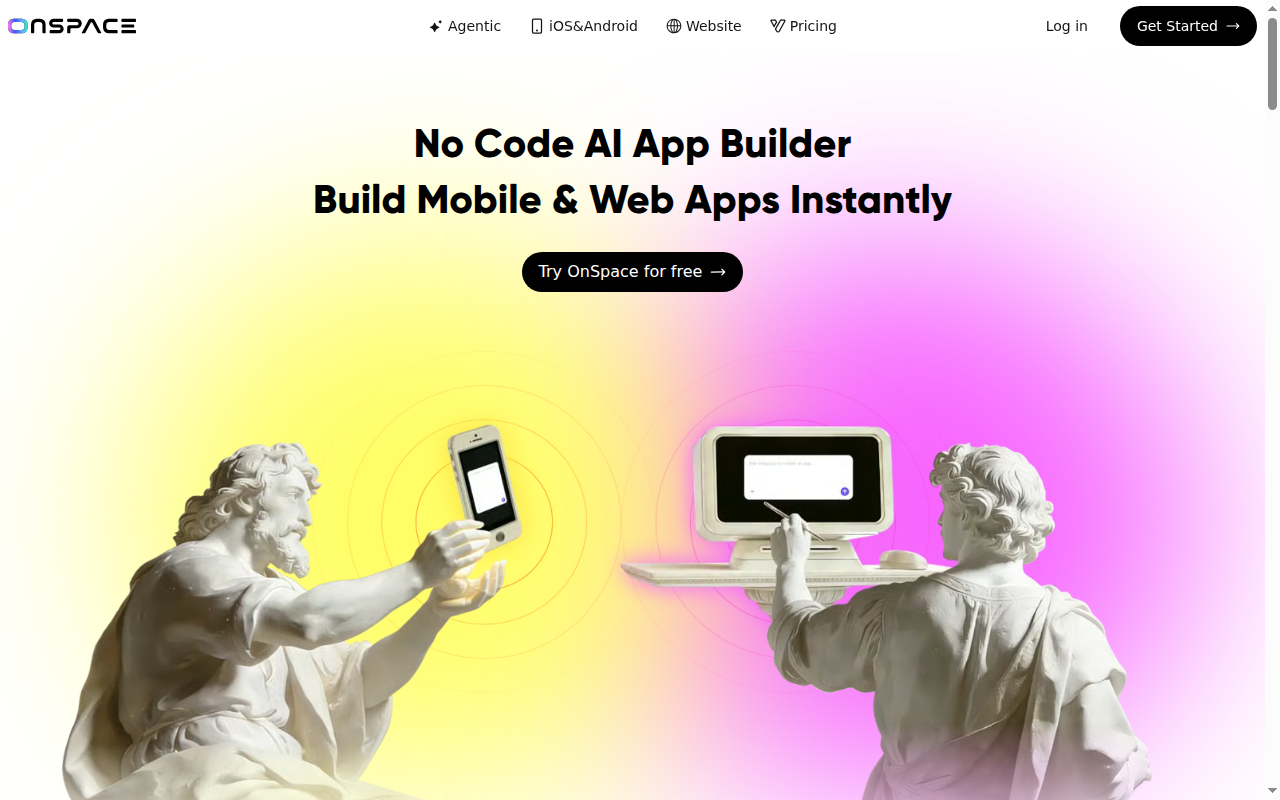
That difference matters because OnSpace AI is selling a fuller "idea to app" journey than a typical developer platform. The homepage and pricing materials emphasize web, iOS, and Android app generation, managed backend services, Stripe support, auth, edge functions, logs, and a mobile creator workflow. Replit can support ambitious products, but its public story still begins with software development. OnSpace begins much closer to autonomous app creation.
If your priority is speed to a working app without hiring a developer or assembling infrastructure yourself, OnSpace AI is a credible Replit alternative. If your priority is code ownership, conventional engineering control, and software you expect to evolve under a technical team for a long time, Replit is usually the safer choice.
OnSpace AI vs. Replit: Quick Comparison
| Decision area | OnSpace AI | Replit |
|---|---|---|
| Primary approach | AI no-code app builder for web and mobile apps | Code-first cloud development environment with AI assistance |
| Output model | Managed app builder with backend and deployment included | Developer workspace where apps are built in code |
| Web output | Officially supported | Officially supported |
| Mobile story | Explicit iOS and Android app-building positioning | Less central to the public positioning |
| Backend | Managed database, auth, edge functions, secrets, and logs | Possible, but more developer-assembled |
| Payments | Homepage explicitly highlights built-in Stripe integration | Possible through custom implementation |
| Editing model | Prompt-led generation plus code editor and mobile creator app | Mostly code editing with AI help |
| Deployment | Instant ship-to-production framing | Built-in deployment remains a major Replit strength |
| Access model | Usage and credit oriented | Developer-platform economics and workload patterns |
| Private projects | Called out as part of the paid plan | Possible within normal project workflows |
| Custom domains | Called out on the paid plan | Possible, but less important to the core pitch |
| Portability | Not publicly positioned as code-export-first | Usually easier to map to long-term code ownership |
| Free plan | Free plan with public projects and capped credits | Accessible, but not framed as a mobile-plus-no-code funnel |
| Paid entry | Public pricing shows a $25/month Pro plan | Can be more economical for already-technical builders |
| Best fit | Non-technical or mixed teams seeking product speed | Builders who want AI leverage without surrendering code-first workflows |
What OnSpace AI Does Differently
It pushes the "idea to live product" promise harder than many Replit alternatives
OnSpace AI does not merely promise a generated interface. Its public materials talk about a fully managed backend, database, auth, edge functions, secrets, logs, and shipping to production. That makes the product feel closer to an autonomous software assembly layer than a prototyping toy.
This matters in the Replit comparison because many buyers are not just shopping for another place to code. They are shopping for a way to remove the entire setup tax. OnSpace AI is compelling precisely because it tries to absorb that setup tax into the platform.
Mobile is part of the core product story, not an afterthought
OnSpace AI explicitly markets iOS, Android, and web app building, and it also promotes a mobile creator app for editing on the go. That is not the usual posture for AI builders that only quietly support responsive web output. If a buyer's roadmap includes mobile from the start, OnSpace feels more naturally aligned than many app builders that still think primarily in browser-first terms.
Replit is still powerful for technical teams building mobile-adjacent infrastructure, but mobile is not where most buyers instinctively see its strongest advantage. OnSpace AI benefits from leaning directly into that use case.
Its commercial model is built around credits and AI capability tiers
The pricing page makes it clear that OnSpace AI is not simply a flat software subscription. The free plan is credit-capped, the paid plan expands monthly credits, and the value proposition includes advanced AI coding models plus faster generation. That means the buyer is paying not only for access, but for how much autonomous software work the platform can do.
That can be worth it when there is no technical team in place, or when iteration speed is the main bottleneck. It also introduces cost-at-scale questions that are less abstract in Replit, where technical builders can often control more of the workflow manually.
Known Limitations
- Credit-based economics make cost predictability weaker than they initially appear. Heavy generation workflows can become more expensive as app complexity and iteration volume increase.
- OnSpace AI is more managed and more abstract than Replit, which makes long-term portability less obvious from the public materials.
- The platform is optimized for speed and integrated execution, not for teams that want every architectural decision to remain visible and code-led.
- The strongest fit is straightforward to medium-complexity apps. Very custom products or unusual architecture may eventually outgrow the abstraction faster than they would outgrow Replit.
- The mobile promise is attractive, but buyers should still validate the maturity of the exact mobile workflow they need before committing serious product plans to it.
Who Should Choose OnSpace AI Over Replit?
- Founders who want to move from idea to live web or mobile app quickly without building the stack manually.
- Non-technical builders who need backend, auth, payments, and hosting included in the same product surface.
- Teams that value conversational generation and integrated infrastructure more than code ownership.
- Operators who want to test product ideas fast and are comfortable with a usage-based AI platform model.
When Replit Is Still the Better Choice
- Stay with Replit if your team wants deeper control over architecture, dependencies, debugging, and long-term code maintenance.
- Stay with Replit if cost predictability matters more than autonomous app generation speed.
- Stay with Replit if portability and code stewardship are core buying criteria from the first week.
- Stay with Replit if your product already assumes an engineering team rather than a builder-first workflow.
Pricing Comparison & Cost at Scale
Plan overview
- OnSpace AI publicly shows a Free plan at $0/month.
- The Free plan includes public projects, the web and mobile AI builder, agent mode on a usage basis, and a code editor.
- Public page content shows a Pro plan at $25/month with up to 7,500 credits per month, advanced AI coding models, private projects, badge removal, custom domains, and fast-track generation.
- Pricing copy elsewhere on the page also mentions a free plan with 500 daily credits up to 2,000 monthly maximum.
Prices are subject to change. Confirm current credit allowances and plan names on the official pricing page before buying.
The cost story here is classic agentic-builder economics. OnSpace AI may feel cheap at the start because it compresses so much setup work into one product. But credits are the real control point. If the app requires frequent regeneration, repeated fixes, or lots of experimentation, the effective monthly cost can rise faster than a plain subscription suggests.
That is not automatically a weakness. For a founder without developers, paying for generated momentum can still be the right decision. But compared with Replit, OnSpace AI is more likely to become expensive through usage intensity rather than through a simple seat count. Buyers should think in workflows, not just plan labels.
| Scenario | OnSpace AI | Replit | Verdict |
|---|---|---|---|
| Non-technical founder MVP | Very strong fit | Possible but more demanding | OnSpace AI usually wins on startup speed. |
| Web plus mobile ambition | Strong fit | Less central to positioning | OnSpace AI has the clearer public mobile story. |
| Technical team shipping a long-run product | Mixed fit | Stronger fit | Replit is better for maintainable code-centric execution. |
| Usage-heavy iterative build loop | Can get expensive | More controllable | Replit may be safer if generation volume becomes high. |
Migration, Lock-in, and Team Fit
OnSpace AI makes the most sense when the bottleneck is not writing better code, but getting from concept to shippable software at all. That is why its bundle of auth, backend, payments, and deployment matters so much. For a founder or operator, the question is often whether the app can exist this month, not whether the architecture is elegant.
The tradeoff is that this convenience usually means more platform dependence. Replit still lives closer to normal software-development expectations, which makes it a better long-term home for products that will be shaped by engineers over time. OnSpace AI is better when the buyer wants the system to carry more of the execution burden upfront.
Team fit is therefore the deciding factor. OnSpace AI is best for founder-led or mixed teams that value speed, integrated infrastructure, and prompt-driven building. Replit is best for technical teams that want AI help without switching the core unit of work away from code.
How OnSpace AI Compares to Other Options in Directory 2929
- Compared with Bolt and v0, OnSpace AI pushes a fuller managed-backend and mobile story rather than focusing mainly on browser-based code generation.
- Compared with Glide or Softr, it leans harder into AI generation and autonomous app creation instead of template-first no-code assembly.
- Compared with Anything, it appears simpler in pricing surface and more explicit about the free-to-Pro credit ladder, though both compete on integrated app creation.
FAQ
Is OnSpace AI a strong Replit alternative?
Yes, for builder-first teams. OnSpace AI is a strong Replit alternative when you want the platform to generate and ship more of the app for you.
Does OnSpace AI support mobile apps?
Yes, officially. Its public materials explicitly mention iOS, Android, and web app building, plus a mobile creator workflow.
Is OnSpace AI better than Replit for developers?
No, not usually. Replit is generally better when developers want lower abstraction and stronger code ownership.
What is the main downside of OnSpace AI?
Credit economics and platform dependence. Those two factors become more important as the product grows and iteration volume increases.
Who gets the most value from OnSpace AI?
Founders, operators, and non-technical builders who need a real app quickly with backend and deployment already handled.
When should you stay with Replit instead?
Stay with Replit when your workflow is engineering-led and the software will need long-run maintenance, custom architecture, and direct code-level control.