
Softr
Contact
Softr
No-code business app and portal builder turning Airtable, Google Sheets, and Notion data into apps with built-in auth.
Softr as a Replit Alternative: Comparison & Decision Guide (2026)
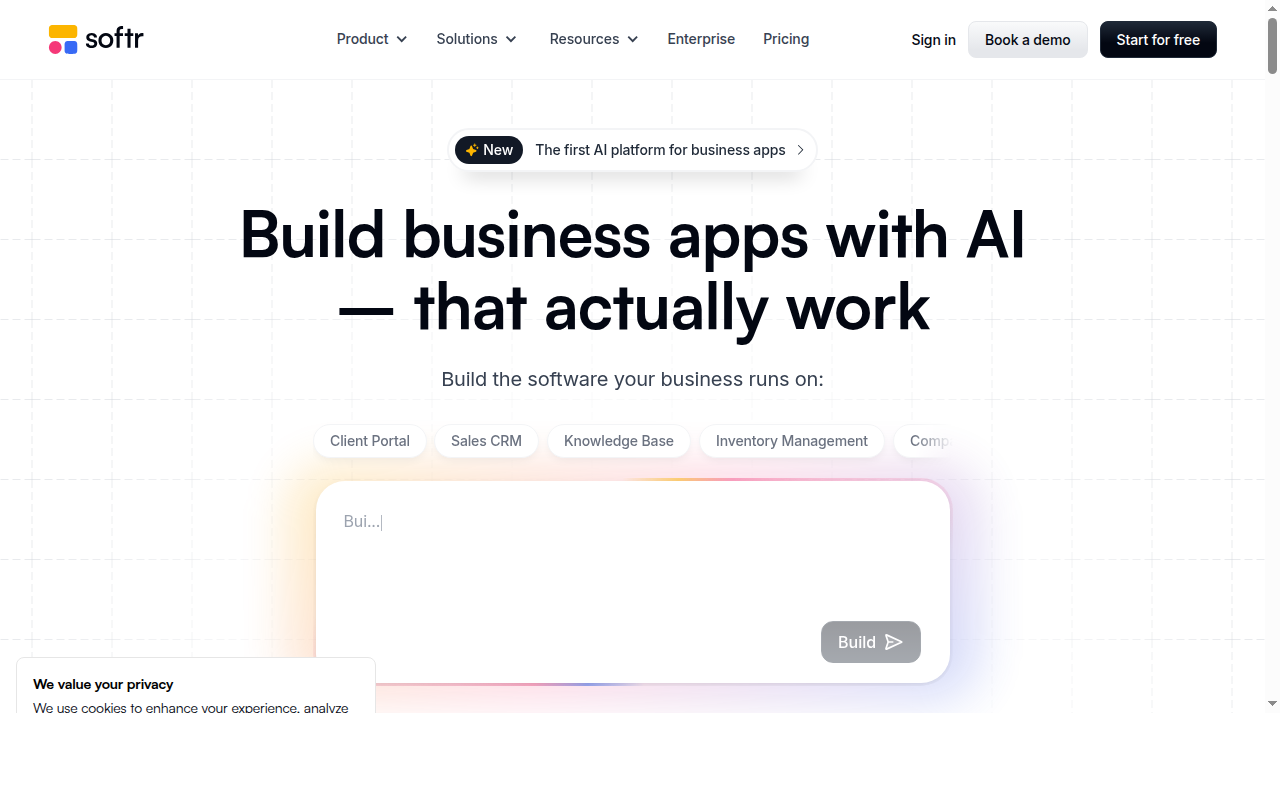
Softr is a no-code business app and portal builder designed to turn data from Airtable, Google Sheets, or Notion into client portals, internal tools, and customer-facing apps — making it a Replit alternative specifically for non-technical teams who need functional business apps without writing code. Where Replit is a developer's code-first platform, Softr is built for marketers, operations teams, and founders who work in spreadsheets and need to wrap them in a real app interface without engineering resources.
The tradeoff: you gain a dramatically lower barrier to building business portals and internal tools, with AI co-build features and a 1M+ user base suggesting real-world reliability. You lose all of Replit's developer flexibility — custom logic, API endpoints, non-trivial backend code, and any use case that goes beyond data display and CRUD operations.
If your use case is a custom app with complex logic, a developer tool, or anything requiring backend programming, Softr is not the right platform — Replit or a code-first alternative will serve you better.
Softr vs. Replit: Quick Comparison
| Decision area | Softr | Replit |
|---|---|---|
| Primary approach | No-code builder: connects data sources to app UI | Code-first browser IDE with AI assist and web deployment |
| Output stack | Web apps, client portals, internal tools (data-driven) | Web, backend, scripts — any language |
| AI capability | AI co-build: helps design and structure app with prompts | Ghostwriter — code completion, generation, chat |
| Visual editing | Core feature — drag-and-drop block builder | Minimal — code-first, no visual drag-and-drop |
| Figma import | Not supported | Not supported |
| Deployment | Softr-hosted; custom domains supported | Replit-hosted; custom domains on paid plans |
| Database | Airtable, Google Sheets, Notion, HubSpot, SmartSuite (data sources, not owned DB) | Replit DB (key-value); PostgreSQL via add-ons |
| Authentication | Built-in user auth, login gates, membership — core feature | Not built-in; via third-party libraries |
| Mobile support | Mobile-responsive web output; no native app publishing | No native mobile app publishing |
| Git/GitHub workflow | Not applicable — no-code platform | GitHub import/export supported |
| Code export / portability | No code export — proprietary platform lock-in | Full code access; can export and self-host |
| Collaboration | Multi-user editor; role-based access for app users | Real-time multiplayer code collaboration |
| Error handling / debugging | No code debugging; data connection issues via UI logs | Built-in debugger, console, error highlighting |
| Pricing model | Seat and record-based tiers; AI credits as add-on | Seat-based with compute limits |
| Free plan | Yes — limited apps and users | Yes — limited compute, public Repls only |
| Paid plans | Basic, Professional, Business, Enterprise (pricing varies by plan — check official site) | Core $25/mo; Teams $40+/mo |
What Softr Does Differently
Spreadsheet-to-App in Hours, Not Weeks
Softr's core value proposition is the fastest path from an Airtable base or Google Sheet to a user-facing app. For a non-technical founder managing clients in a spreadsheet who needs to give those clients a portal to view their own data — Replit would require writing an entire backend API, frontend, auth system, and deployment pipeline. Softr does this in a few hours with no code.
This is a fundamentally different productivity curve: Softr is slower than Replit for complex custom applications, but dramatically faster for data-display and CRUD-heavy business apps with defined data sources.
Built-in Auth and User Management
Softr has user authentication, login gates, role-based access, and membership features built into every plan. This is significant because auth is one of the most time-consuming, security-critical parts of building any app on Replit — you'd need to integrate a third-party auth provider (Auth0, Clerk, etc.) and wire it to your codebase. Softr ships this by default.
For client portal and internal tool use cases — the primary Softr use case — this built-in auth means you can deploy a secure, user-specific experience without an engineering sprint.
AI Co-Build Guided by Business Context
Softr's AI co-build feature is designed around business app creation, not general code generation. You describe the kind of app you want, and the AI helps structure blocks, layouts, and data connections. This is narrower than Replit's Ghostwriter but more focused for non-technical users who don't know what they don't know about app architecture.
The result: a faster, more opinionated starting point for common use cases (project tracker, client portal, job board, directory) vs. a blank slate IDE approach.
Known Limitations
- No code export — full platform lock-in: Unlike Replit, Softr does not export your app as code. If you outgrow Softr, you cannot migrate to another platform without rebuilding from scratch. This is a serious long-term risk for any product with growth ambitions. Replit gives you code ownership; Softr does not.
- Logic ceiling for complex applications: Softr handles CRUD operations and data display well, but complex business logic (conditional workflows, multi-step automations, custom API integrations beyond listed sources) hits a hard ceiling quickly. Replit has no such logic ceiling — it runs arbitrary code.
- Dependent on external data sources: Softr connects to Airtable, Google Sheets, and others — but it doesn't own a database. If your data source changes pricing, API, or availability, your Softr app is affected. Replit applications own their own data layer.
- AI credits as a separate add-on cost: AI features in Softr require additional credits beyond plan pricing. This introduces cost unpredictability for teams that rely heavily on the AI co-build feature.
- No native mobile app publishing: Softr builds mobile-responsive web apps, not native iOS or Android apps. If you need App Store presence, Softr cannot deliver it — neither can Replit, but both have the same gap here.
- Not a developer tool: Developers will find Softr frustrating — no code access, no custom logic, no debugging tools in any developer sense. This is a non-coder platform designed for business users, not a Replit replacement for engineers.
Who Should Choose Softr Over Replit?
- Non-technical founders or operators building client portals: If you're managing client relationships in Airtable and need to give clients a self-service portal without hiring a developer, Softr delivers this in hours. Replit would take days or weeks.
- Operations teams building internal tools from existing spreadsheets: If your team tracks projects, tasks, or inventory in Google Sheets and needs an app interface for non-technical employees, Softr provides the fastest path without engineering involvement.
- Solopreneurs building simple marketplaces, job boards, or directories: Softr's block templates for these use cases are pre-built and deployable quickly. Replit requires building these from scratch.
- Teams where user auth and access control are needed out of the box: Softr's built-in membership and login system removes a significant engineering workload. For teams without backend engineering resources, this is a decisive advantage.
When Replit Is Still the Better Choice
- You need custom business logic: Any app that requires conditional workflows, custom calculations, or integration with APIs not on Softr's connector list needs Replit or a code platform.
- You want to own your codebase: Replit gives you full code access and portability. Softr locks you in completely. For any product with long-term growth plans, code ownership matters.
- Your team includes developers: Developers will not be productive in Softr. Replit is built for developers. Mixed teams should evaluate carefully — Softr may empower non-technical members but frustrate developers.
- You need a non-Airtable/Sheets data layer: If your data lives in PostgreSQL, MongoDB, or a custom API, Softr's connector model doesn't work. Replit connects to anything via code.
- You need performance or custom infrastructure: Replit deployments are configurable; Softr is fully hosted and opaque in its infrastructure choices.
Pricing Comparison & Cost at Scale
Softr Plan Overview
- Free: Limited apps and internal users
- Basic / Professional / Business / Enterprise: Pricing varies; check official site. AI credits are a separate add-on cost.
- Key cost driver: Number of internal users (team members who build or admin the app) and external app users (clients/customers accessing the app)
Replit Plan Overview
- Free: Public Repls, limited compute
- Core: $25/mo per user
- Teams: From $40/mo per user
| Scenario | Softr | Replit | Notes |
|---|---|---|---|
| Solo founder, simple client portal | Free → low-tier paid | $25/mo Core + dev time to build | Softr much faster for this use case |
| 5-person team, internal tool | Business tier pricing (check site) | $125+/mo (5x Core) + engineering time | Softr may be cheaper if team is non-technical |
| Growing app with complex logic | Hits logic ceiling — rebuild needed | Scales with code complexity | Replit wins at scale; Softr has a glass ceiling |
Prices are subject to change. Check the official Softr pricing page for current plan details. AI credits are billed separately from plan costs.
How Softr Compares to Other Options
- vs. Glide: Both are no-code app builders targeting spreadsheet users. Softr focuses more on client portals and business apps; Glide focuses on web apps from data with a slightly more polished mobile-responsive experience. Glide has a 25K row cap; Softr's data limits depend on your connected source. If auth and membership are critical, Softr's built-in auth is stronger.
- vs. Bubble: Bubble is a no-code platform with more logic capabilities — closer to a full application builder with its own database. Softr is simpler but more limited in logic depth. For complex no-code apps, Bubble scales further; for fast client portal deployment, Softr is faster to launch.
- vs. Adalo: Adalo builds native mobile apps; Softr builds web portals and internal tools. They serve different primary use cases. If you need App Store presence, Adalo is relevant; if you need client portals or web-based internal tools, Softr wins.
FAQ
Is Softr free?
Yes, Softr has a free plan with limited apps and internal users. Paid plans unlock more apps, users, and features. AI credits for the AI co-build feature are a separate cost on top of plan pricing — factor this in if you'll use AI features regularly.
Can Softr replace Replit?
Only for non-technical teams building data-driven business apps. Softr cannot replace Replit for any use case requiring custom code, complex logic, or developer workflows. For non-coders building client portals or internal tools from spreadsheet data, Softr is genuinely faster and more appropriate than Replit.
What data sources does Softr support?
Airtable, Google Sheets, Notion, HubSpot, and SmartSuite are among the documented data sources. Softr connects to these external sources — it does not own its own database. Your app is dependent on your connected data source's availability and API.
Is Softr good for beginners?
Yes — for non-technical beginners building business apps. The drag-and-drop builder and AI co-build features are designed for users with no coding background. Technical beginners learning to code should use Replit or a code-first platform instead.
What is the lock-in risk with Softr?
High. Softr does not export your app as code. If you outgrow the platform or Softr changes pricing significantly, you cannot migrate your app — you must rebuild it on another platform. For production apps with growth expectations, this is a serious long-term consideration.