
Stacker
Contact
Stacker
AI-native application platform for internal tools, CRMs, dashboards, and portals with prompt-based setup, no-code refinement, and scalable business permissions.
Stacker as a Replit Alternative: Comparison & Decision Guide (2026)
Stacker is a credible Replit alternative for operations teams, agencies, customer portals, vendor portals, internal tools, CRMs, dashboards, and organizations that need multi-user business apps more than product-led front-end originality. The real appeal is not that it can also use AI. The real appeal is that it can remove a lot of product, workflow, or portal setup before a team ever has to think like a software engineering shop.
The trade-off against Replit is clear. Replit is better when the project behaves like software that needs direct code ownership, repeated debugging, and long-lived developer maintenance. Stacker is better when the bottleneck is getting a useful app, workflow, or portal live fast without moving deeper into engineering process than the team really wants.
If your team is asking whether Replit feels too code-heavy for the job in front of you, Stacker deserves a serious look. If your team is asking how to preserve flexibility after the first version ships, Replit usually remains the safer default.
Stacker vs. Replit: Quick Comparison
| Decision area | Stacker | Replit |
|---|---|---|
| Primary approach | internal tools, CRMs, dashboards, client portals, supplier portals, and structured business applications with multiple user types | Browser-based coding workspace with AI help for building and shipping software |
| Builder style | AI-assisted app creation, AI-native setup, and an AI builder that can generate a starting app from a plain-language description | Code-first development with AI assistance inside an IDE-like environment |
| Output stack | Managed AI-native application platform with relational business data, portals, integrations, and no-code refinement | Editable code project oriented around web apps and developer workflows |
| Visual editing | Yes; Stacker positions AI generation together with no-code control instead of replacing visual refinement entirely | Preview-first, but still much more code-centric than no-code builders |
| Database model | Relational business-app data model with integrations and operational workflow support | Integrated databases and storage that suit developer-managed apps |
| Authentication | Strong multi-user and portal-oriented permissions story is part of the core positioning | Developer-oriented auth and deployment tooling |
| Deployment | Hosted deployment inside Stacker with managed access, user roles, and portal distribution | Built-in hosting and deployment for software projects |
| Mobile support | Web-first business app access; mobile-native publishing is not the center of the product story | Web-first, with mobile usually handled through the app stack you choose |
| Portability | Code export is not the story; the value is managed delivery, permissions, and operational app structure rather than repo ownership | Stronger default expectation of code ownership and exportability |
| Collaboration | Very strong for operations because the app model is explicitly built around different user types, portals, and business processes | Better fit for engineering collaboration and iterative code maintenance |
| Debugging | More suited to workflow and operations refinement than to classic software debugging or engineering customization | Much stronger for debugging, refactoring, and fixing generated code over time |
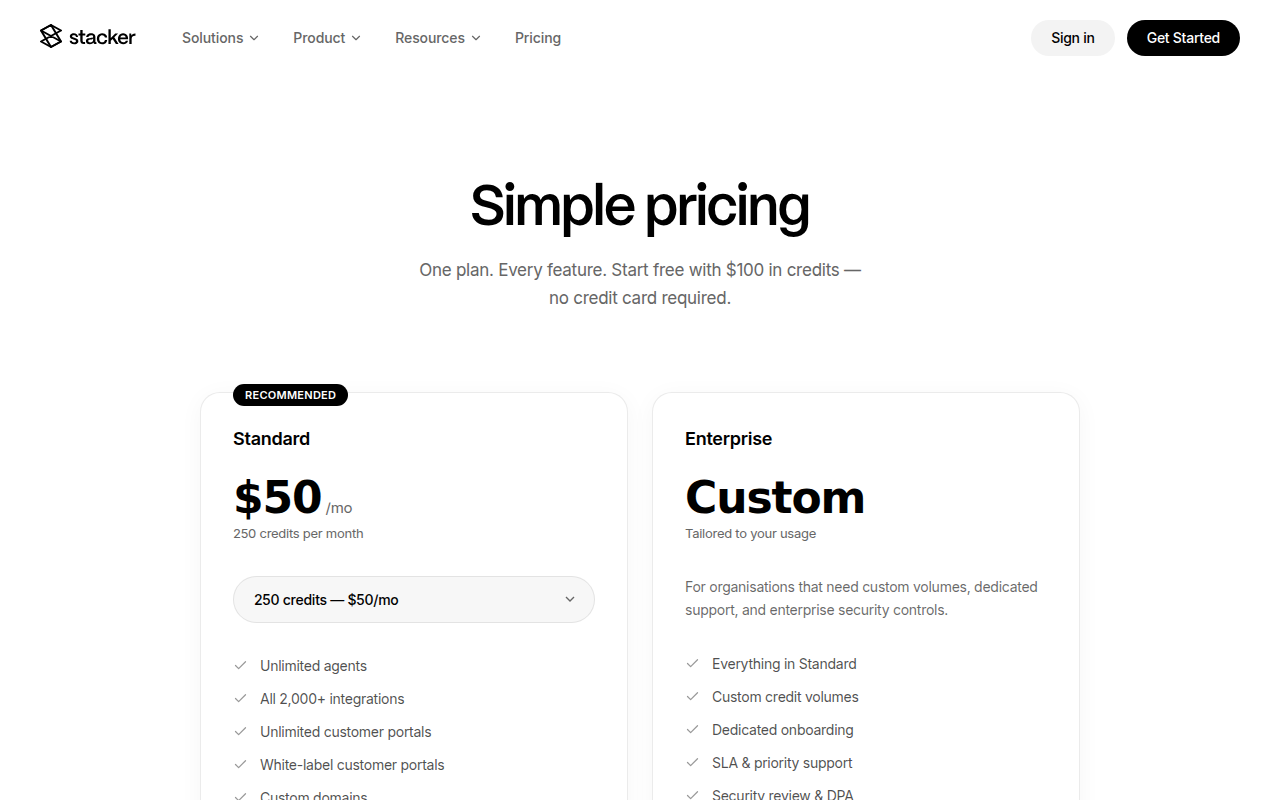
| Pricing model | Public pricing starts at $50 per month for the Team plan with 250 credits per month | Subscription platform value tied to development environment and AI-assisted build flow |
| Free plan | Start free with $100 in credits and no credit card according to the public pricing page | Entry path exists, but the main value is in developer workflow depth rather than no-code convenience |
| Best fit | operations teams, agencies, customer portals, vendor portals, internal tools, CRMs, dashboards, and organizations that need multi-user business apps more than product-led front-end originality | Founders and developers who want to keep a tighter grip on code and product iteration |
What Stacker Does Differently
Most Replit alternatives talk about AI generation. That is not enough. A useful alternative must also solve a different workflow problem than Replit solves. In practice, Stacker stands out for the following reasons.
It is built for multi-user business systems, not startup product storytelling
Replit shines when a founder wants a code-centric workspace and a fast route to shipping software with direct code control. Stacker is sharper when the app exists to coordinate customers, suppliers, staff, or partners in a structured operational workflow.
Its AI builder lives inside a portal-and-operations framework
That changes the output. Instead of trying to become a flexible product canvas for everything, Stacker focuses the result around CRMs, dashboards, portals, and business process control.
It optimizes business governance more than code freedom
The reason to choose Stacker is not source-code export. It is that permissions, integrations, external-user access, and operational app patterns are treated as first-class concerns from the start.
Known Limitations
This is where the comparison gets honest. Stacker can be the better choice for the right buyer, but it is not a universal upgrade over Replit.
- It is less compelling than Replit when the goal is a standalone product with a distinctive front end and a future engineering handoff.
- The platform story is strongly operational, so teams chasing consumer-facing product aesthetics may feel boxed in.
- Because code ownership is not the main promise, Stacker is weaker for companies that already know they want an app to leave the platform later.
- The AI builder direction is promising, but the long-term evaluation still depends on how much managed-platform structure your team is willing to accept.
Who Should Choose Stacker Over Replit
The strongest reason to choose Stacker is not that it looks modern or AI-native. It is that the platform model aligns better with the real operating shape of the app you want to launch. If your app is closer to a portal, dashboard, internal tool, or workflow surface than to a software product maintained by developers every week, this platform can remove meaningful friction.
- Choose Stacker when the app needs multiple user types, permissions, and portals more than product-polish freedom.
- Choose it when operations teams need to build internal or external business software without waiting on engineers.
- Choose it when a managed business-app platform is more valuable than code export.
- Choose it when CRMs, dashboards, client portals, or supplier portals are closer to the real use case than a startup MVP.
When Replit Is Still the Better Choice
Replit stays stronger when the future of the app matters as much as the first draft. That includes debugging, product iteration, handoff to developers, and situations where owning the project structure is a strategic requirement rather than a nice-to-have.
- Stay with Replit when the project is a product-first MVP and a code-friendly evolution path matters.
- Stay with Replit when front-end originality and startup-style product iteration are bigger priorities than portal governance.
- Stay with Replit when you want a simpler mental model tied to product generation rather than operational app administration.
- Stay with Replit when the app is meant to become a developer-owned software product rather than a managed business system.
Pricing Comparison and Cost at Scale
Sticker price is only the first layer of this decision. With Replit alternatives, the bigger question is what becomes expensive after the first app is live: extra users, more operations, more AI usage, more integrations, or the eventual need to move away from the platform.
- Stacker keeps pricing simpler than many operational app builders because the public page presents one paid plan plus credits instead of a long matrix of editions.
- The free entry path is generous enough for evaluation, but the real cost question is how quickly your operational app burns through credits once teams build more than one portal or workflow.
- For portal-heavy business apps, the value proposition can beat user-based tools because the platform emphasizes unlimited customer portals and a managed multi-user model.
Start free with $100 in credits and no credit card according to the public pricing page
Public pricing starts at $50 per month for the Team plan with 250 credits per month
Prices are subject to change. Check the official pricing page before making a production decision.
| Scenario | Stacker | Replit | Why it matters |
|---|---|---|---|
| First prototype or internal workflow | Usually faster to useful output | More setup and code thinking | Stacker wins if speed and low-code iteration matter most. |
| Repeated debugging and custom logic | Can become limiting | Usually stronger | Replit is better when the app is becoming real software, not just a generated surface. |
| Long-term ownership | Depends on platform tolerance | Safer default | Replit gives better long-run confidence when code portability and maintenance matter. |
Decision Matrix
A practical way to compare Stacker with Replit is to ignore generic feature lists and ask which environment is better matched to the specific job. The quick calls below capture that decision logic.
- Need a CRM, dashboard, or external portal with strong user roles: Stacker
- Need a startup-style MVP with a clearer code-forward future: Replit
- Need internal or external operations software for multiple audiences: Stacker
- Need product experimentation and front-end freedom first: Replit
Lock-In, Portability, and Team Risk
Stacker's strength is exactly where lock-in grows: portals, permissions, relational business logic, and managed application delivery. If those pieces are what remove the hardest operational work for your team, the platform dependence can be rational and efficient.
If you already suspect the app needs to become a custom software asset with engineering-led ownership later, Stacker is harder to justify than Replit because the platform value is tightly coupled to staying inside its managed operational model.
That is the central Replit trade-off. Replit can feel heavier at the beginning because it keeps the user closer to code and software-development workflow. But that same heaviness often becomes an advantage when the app lives longer, grows stranger, or needs hands-on technical intervention from real developers.
Workflow Fit and Migration Reality
Compared with Replit, Stacker feels like a business-app operating layer rather than a product ideation engine. It is well suited to teams that judge success by cleaner operations, better access control, and faster rollout of multi-user business workflows.
It is not the strongest choice for product teams that want an AI builder to be the first step toward a more custom engineering roadmap.
If your likely future includes refactoring, handoff to an engineer, or a need to debug deeper product behavior, Replit usually offers the clearer path. If your future mostly involves adjusting workflows, screens, and operational logic without turning the app into an engineering-first asset, Stacker can be the better fit.
What Builders Are Saying
Third-party reviews position Stacker as a serious option for operational business apps, especially where portals and structured access matter. The positive pattern is managed multi-user delivery with AI-assisted setup; the caution is that it solves a more operational problem than the code-centric software-building path that makes Replit attractive.
- https://hackceleration.com/stacker-review/
- https://www.capterra.com/p/203160/Stacker/
- https://makerstack.co/reviews/stacker-review/
Final Verdict
Stacker is a good Replit alternative when the real goal is not software craftsmanship for its own sake, but faster delivery of a useful app surface for operations, portals, dashboards, or business workflows.
Replit is still better when the app is likely to become a developer-owned software product that needs deeper debugging, clearer code control, and more flexible maintenance over time. The safest buying move is to rebuild one real workflow in both tools and compare not only how quickly the first version appears, but also how comfortable the second and third rounds of change feel.
Sources
- https://stacker.ai/
- https://stacker.ai/pricing
- https://stacker.ai/blog/introducing-stacker-ai
- https://hackceleration.com/stacker-review/
- https://www.capterra.com/p/203160/Stacker/
- https://makerstack.co/reviews/stacker-review/
FAQ
Is Stacker a good Replit alternative?
Yes, for operational apps. It is a strong Replit alternative when the real need is a CRM, dashboard, or portal rather than a code-minded startup MVP.
Does Stacker have a free plan?
Yes. The public pricing page says you can start free with $100 in credits and no credit card.
Who should choose Stacker over Replit?
Operations and portal-focused teams. It is especially useful for internal tools, client portals, supplier workflows, and structured multi-user business apps.
What is the biggest caution?
Managed-platform dependence. The more value you get from portals, permissions, and operational structure, the more your app stays tied to the Stacker platform.