
Zite
Contact
Zite
AI no-code app builder for internal tools, workflows, and database-backed business software.
Zite as a Replit Alternative: Comparison & Decision Guide (2026)
Zite is a good Replit alternative for teams that want to build internal software, workflows, and database-driven business apps without centering the process on code. It is stronger than Replit when the buyer cares more about shipping controlled business apps for operations teams than about owning a developer-first coding environment. It is weaker than Replit for technical teams that need deep code-level flexibility, conventional engineering workflows, and predictable portability from day one.
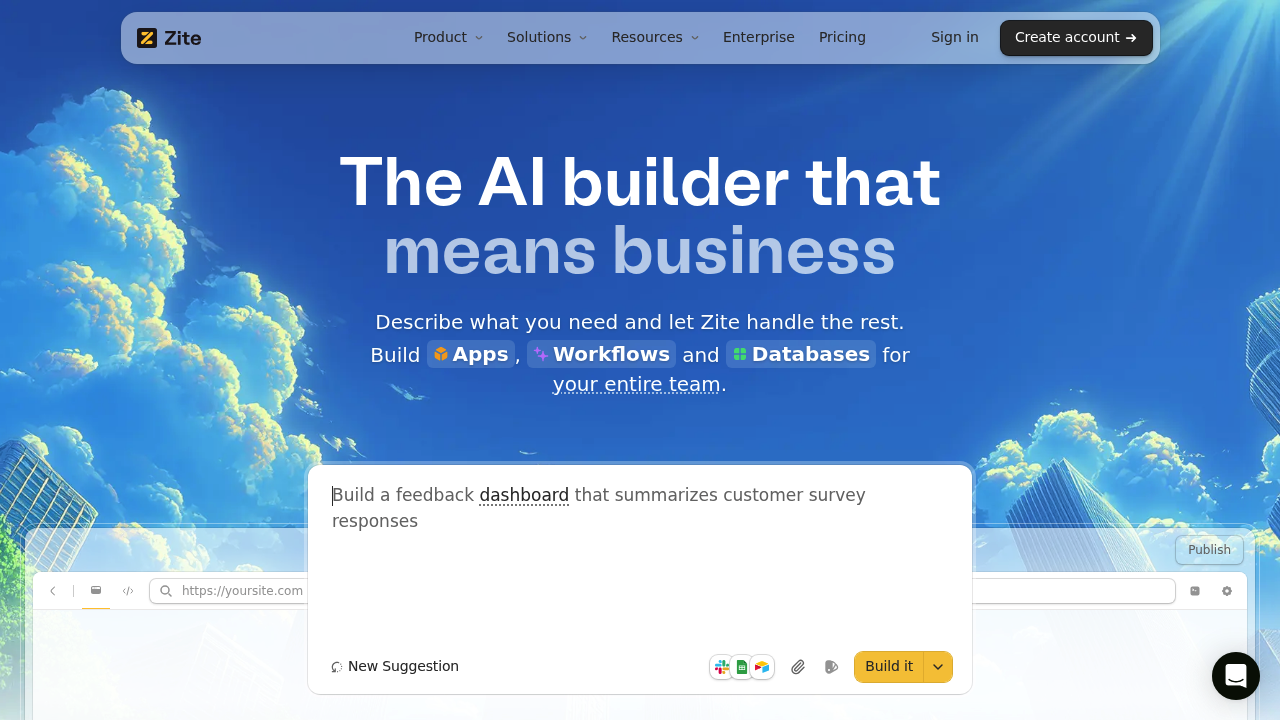
Zite positions itself as an AI builder for apps, workflows, and databases, which changes the comparison immediately. Replit gives buyers a general-purpose software environment with AI assistance layered into coding and deployment. Zite instead tries to collapse the journey into prompt-led business app creation with built-in auth, database, hosting, permissions, and integrations. That makes it attractive for operators, founders, and internal-tool teams that want outcomes faster than they want engineering ceremony.
The main caution is that Zite looks best when the app is operational software, customer portals, or internal workflows rather than a deeply custom software product. If your long-term plan involves custom architecture, heavy debugging, specialized runtime behavior, or a team of engineers iterating on a codebase for years, Replit usually remains the safer bet.
Zite vs. Replit: Quick Comparison
| Decision area | Zite | Replit |
|---|---|---|
| Primary approach | AI-led no-code builder for apps, workflows, and databases | Developer platform with cloud coding, deployment, and AI assistance |
| Output stack | Managed business apps with hosting, auth, and database included | Code-first projects with deployment and infrastructure services |
| Best app type | Internal tools, portals, operational apps, dashboards | General software products, prototypes, scripts, and code-centric apps |
| Visual editing model | Prompt-led builder with editable business logic and templates | Mostly code and AI-assisted development |
| Database | Built-in database positioned as spreadsheet-simple and scalable | Possible, but more developer-managed |
| Authentication | Built-in login, magic link, Google, and SSO options | Possible, but typically assembled in a code workflow |
| Permissions | Granular roles, groups, workspaces, and access controls | Possible through app logic, not a built-in business-admin focus |
| Hosting | Built in by default | Built in and one of Replit's strongest features |
| Integrations | Positioned around existing business tools and data connections | Flexible, but more manual and engineering-driven |
| Branding | Custom domain and design-system alignment are part of the pitch | Possible, but less core to the product story |
| Collaboration | Team-safe app creation for non-developers and operators | Better for developers collaborating in code |
| Portability | Not publicly positioned as export-first | Usually easier to reason about as a codebase |
| Pricing model | Flat-fee positioning, unlimited users, no per-seat charges | More developer-platform shaped and usage-dependent |
| Free plan | Public pricing signals a free entry tier | Accessible, but not framed as a no-code app-building funnel |
| Paid entry | Public page source exposes paid tiers from $15 and $55 | Can be cheaper if the team already knows how to build with code |
| Best fit | Business teams that need software quickly with governance | Technical teams that want AI acceleration without leaving code |
What Zite Does Differently
It treats business app delivery as the product, not coding as the center of gravity
Zite is not trying to win the Replit comparison by being a slightly different IDE. Its homepage puts apps, workflows, and databases at the center, which suggests a buyer journey closer to "we need software for a business process" than "we need a place to write software." That matters because a lot of Replit-alternative searches come from teams who no longer want to start with repositories, packages, and engineering setup just to validate an internal workflow.
For those buyers, Zite can feel more direct. The value is not simply faster coding. The value is reducing the amount of coding that needs to happen at all before a usable internal app exists.
Governance and permissions are part of the pitch much earlier
Zite emphasizes groups, workspaces, granular permissions, SSO, and role-based access much more explicitly than most consumer-leaning AI app builders. That makes it a stronger Replit alternative for operational teams inside companies that care about who can see data, who can edit workflows, and how internal software gets rolled out safely.
Replit can absolutely support governed applications, but doing so depends more on how the app is designed. Zite tries to move some of that concern into the platform layer itself, which is important for non-engineering teams that still need enterprise-style guardrails.
Its pricing story favors organization-wide rollout rather than per-seat friction
The public pricing messaging on Zite's pricing page emphasizes flat-fee plans, unlimited users, and no per-seat charges. That changes the cost conversation meaningfully. Replit can be economically attractive for developer workflows, but Zite is clearly speaking to teams that want to ship software to many users without having the pricing model punish every additional user or stakeholder.
That is especially relevant for internal tools and portals. A platform can look cheap until distribution begins. Zite's messaging implies it wants to remove that expansion tax, which makes it easier to justify as a Replit alternative for ops-heavy environments.
Known Limitations
- Pricing is partially visible but still less transparent than a plain engineering toolchain. The page clearly signals free plus paid tiers from $15 and $55, but buyers should still confirm plan boundaries and implementation support before committing.
- Zite is more opinionated than Replit about what kind of software should be built. That helps for internal tools, but it narrows flexibility when a team wants unusual architecture or deeply custom product behavior.
- Portability is not a front-and-center part of the public positioning. Replit usually wins when code ownership, migration optionality, or handoff to a full engineering team matters early.
- The strongest story is around business apps and operational workflows, not around developer-native product creation. That means technical builders may outgrow the abstraction faster than they would outgrow Replit.
- The platform claims strong governance and security posture, which is valuable, but that also means buyers need to trust the vendor layer more heavily than they would with a simple code-first workflow.
Who Should Choose Zite Over Replit?
- Operations teams that need internal software, portals, or dashboards without waiting for a full engineering backlog slot.
- Founders and operators who want AI-generated business apps tied to permissions, forms, data, and workflows rather than a raw coding environment.
- Organizations that care about unlimited-user economics because the software will be distributed broadly inside the company.
- Teams that need app-level governance, SSO, and role controls earlier than they need low-level engineering customization.
When Replit Is Still the Better Choice
- Stay with Replit if your software roadmap depends on owning and shaping the application at code level from the beginning.
- Stay with Replit if the team expects debugging depth, custom runtime behavior, or unconventional architecture that no-code abstractions may fight.
- Stay with Replit if long-term portability matters more than immediate business-app velocity.
- Stay with Replit if the builders are developers first and non-technical app consumers second.
Pricing Comparison & Cost at Scale
Plan overview
- Zite's public pricing page markets a free entry tier.
- Page-source evidence exposes paid tiers from $15 and $55.
- The same pricing page emphasizes flat-fee plans, unlimited users, and no per-seat charges.
- Enterprise-style positioning appears tied to governance, security, and scale requirements.
Prices are subject to change. Verify the latest details on the official pricing page before making a purchase decision.
The most important economic difference versus Replit is not just the monthly sticker price. It is the rollout model. Zite appears optimized for software that many non-builders will use, which is why unlimited users and no per-seat charges are such central claims. That can make Zite cheaper than Replit-aligned workflows when the real cost is not coding time, but operational distribution across teams.
On the other hand, if the company already has technical staff who are comfortable working directly in code, Replit may remain the more efficient long-term spend. Paying for abstraction is rational only when the abstraction materially reduces delivery time, coordination cost, and support burden.
| Scenario | Zite | Replit | Verdict |
|---|---|---|---|
| Internal app for many employees | Very strong fit | Possible but more developer-led | Zite usually wins on rollout simplicity and user economics. |
| Founder building ops tooling alone | Strong fit | Good if founder likes code | Zite wins if speed matters more than code ownership. |
| Custom software product with engineering roadmap | Mixed fit | Stronger fit | Replit is safer for long-run engineering control. |
| Governed enterprise workflow app | Strong fit | Possible but more manual | Zite's permissions and SSO story are more directly aligned. |
Migration, Lock-in, and Team Fit
Zite's tradeoff versus Replit is not subtle: it gives buyers a more managed path to software, but also asks them to accept more platform opinion. That can be the correct decision when the real business problem is shipping an internal app safely and fast. It is a weaker decision when the software itself becomes a strategic product with deeper engineering demands.
From a team-fit perspective, Zite is better for mixed teams where operators, managers, or domain experts need to participate directly in building. Replit is better when the center of gravity remains a technical team that wants AI leverage but still thinks in repositories, packages, frameworks, and deployment pipelines.
The lock-in question is therefore practical rather than ideological. If the app exists mainly to support operations and the platform gets that app live in a fraction of the time, lock-in may be acceptable. If the app is the product, or if future re-architecture is likely, Replit provides a more durable starting point.
How Zite Compares to Other Options in Directory 2929
- Compared with Glide and Softr, Zite is more explicitly AI-led in how it frames app creation and workflow generation.
- Compared with v0, Bolt, and Lovable, Zite is less about prompt-to-code creativity and more about governed business software.
- Compared with Frontly, it appears more opinionated around internal operational systems and organization-wide controls.
FAQ
Is Zite a real Replit alternative?
Yes, for business apps. Zite is a real Replit alternative when your goal is building internal software, workflows, or portals without centering the process on code.
Does Zite require coding?
No, not as the default path. Its public positioning is built around describing the app you need and letting the platform handle much of the implementation.
Is Zite better than Replit for developers?
No, not usually. Replit is generally better for developers who want code-level control, conventional engineering workflows, and easier portability.
What is Zite best at?
Business software delivery. Zite looks strongest for internal tools, workflows, portals, and database-backed operational apps with governance needs.
Can Zite work for enterprise teams?
Yes, publicly it leans that way. SSO, audit logs, roles, permissions, and security messaging all suggest it is aiming beyond hobby projects.
What is the biggest tradeoff versus Replit?
Control versus speed. Zite can remove more implementation friction, but Replit usually offers a more durable path when code ownership and engineering flexibility matter.