
Opcode
A desktop GUI and toolkit for coding with Claude Code.
Opcode – Replit alternative
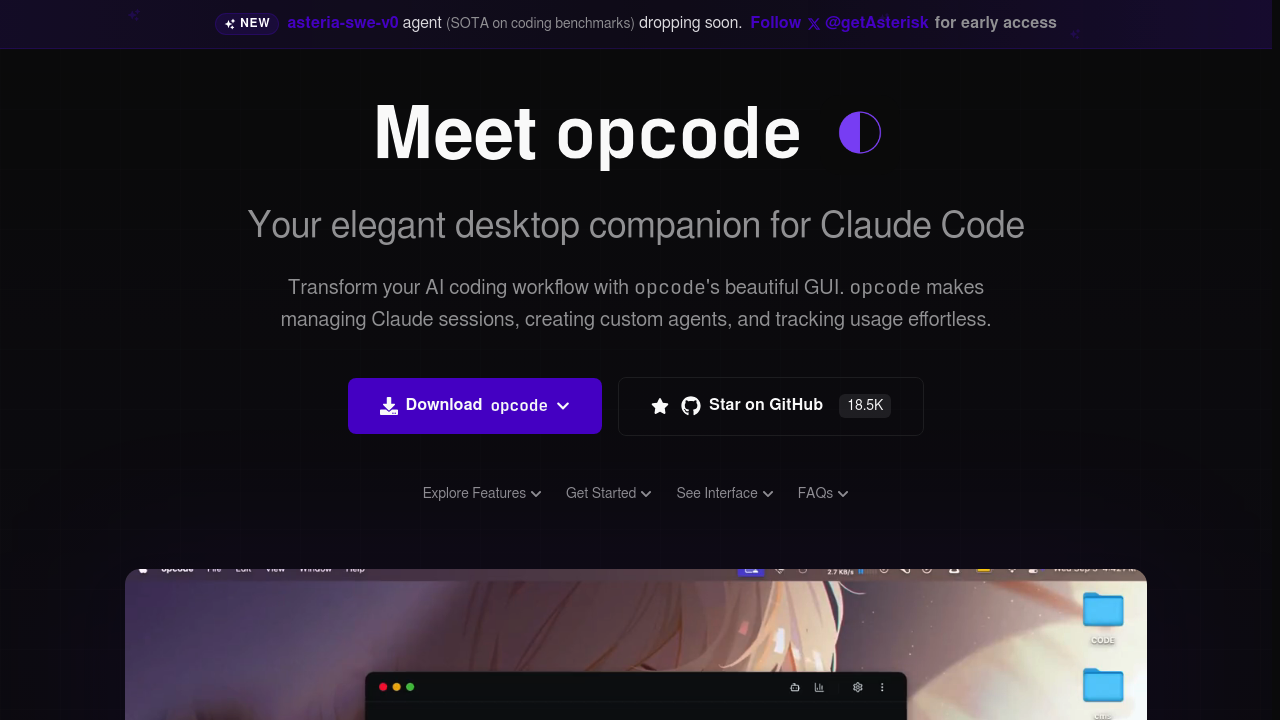
Opcode is a desktop application built to enhance workflows with Claude Code. It provides a visual interface for session and agent management rather than relying only on command-line usage. Solo developers preferring a more GUI-driven environment over plain terminal tools might find it especially useful.
Strengths
- Offers project & session management with branching timeline and checkpoint features.
- Allows creation of custom agents and background execution processes.
- Usage analytics dashboard showing token costs, project breakdowns and exportable data.
- Local storage of data, process isolation and emphasis on privacy (no telemetry).
Weaknesses
- Pricing plans and token-/usage limits are Unknown (no clear official public structure found).
- It is tightly coupled to using Claude Code; if you prefer other models or platforms, this may not be optimal.
- It does not fully replace a full browser-based IDE or cloud IDE with built-in hosting/runtimes.
Best for
Individual developers or small teams who use Claude Code for code generation/management and prefer a desktop GUI workflow.
Tech details
- Type: Desktop application / GUI toolkit for AI-coding (runs locally)
- IDEs: Works as a companion to Claude Code; integrates with your codebase/projects, not a full online IDE.
- Key features: Project & session browser, timeline & checkpoints, custom CC Agents, usage analytics, MCP server registry.
- Privacy / hosting: Data stored locally on your machine; agents run in isolated processes; no telemetry by default.
- Models / context window: Uses Claude Code models via integration (not model host itself). For context window size: the Claude API supports up to ~1 million tokens in certain models.
When to choose this over Replit
- You value a local desktop workflow instead of an online IDE and want direct control of your AI-agent sessions.
- You use Claude Code specifically and want rich session/agent management features, which typical online IDEs may not provide.
- You want to track token usage, cost, and project analytics in a dedicated tool rather than through a web IDE.
When another tool may be a better fit
- You need full cloud-based IDE with hosting of runtime, server deployment, live web apps, and collaborative code editing.
- Your workflow uses models other than Claude Code or you prefer a model-agnostic online environment.
- You require deeply integrated hosting, collaboration, or team features built into the IDE (versus a companion tool).
Conclusion
Opcode is a niche tool tailored for developers working with Claude Code who prefer a desktop GUI experience for managing AI-augmented coding. It does not replace a full online IDE like Replit if you need deployment, collaboration, and runtime hosting. But for solo or small-team workflows focused on code generation and agent management, it offers an appealing alternative.
FAQ
Q1: Does Opcode provide a cloud hosting environment like Replit? No — Opcode is a local desktop GUI tool for managing Claude Code workflows. It does not include hosting or online runtime deployment.
Q2: Which language models can I use with Opcode? You use it alongside Claude Code. The underlying models are from Anthropic (Claude series). Opcode itself does not host models.
Q3: Is there a free tier for Opcode? Unknown — there is no publicly detailed free plan listed on its site at the time of writing.
Q4: Can I collaborate with team members in Opcode? Team/collaboration features are not clearly described; it appears more suited for individual or small-team local use.
Q5: Is my data private? Yes — according to documentation, data is stored locally, agents run isolated processes, and no telemetry is collected by default.
Q6: What is the context window size supported when using Claude models via Opcode? The context window depends on the Claude model you access via Claude Code. Some models support up to ~1 million tokens; others around 200,000 tokens.